
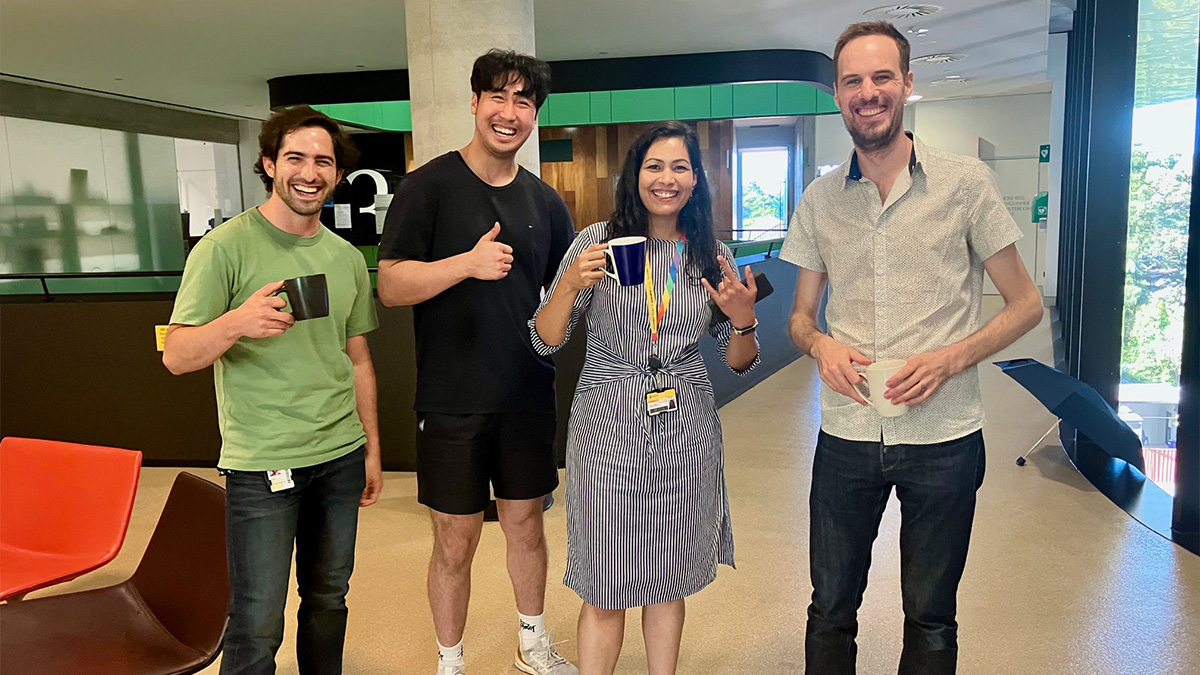
Dr Vaishnavi Ananthanarayanan champions the inclusion of women and gender diverse scientists as the Academic Lead for Science and Gender Equity, part of UNSW’s Athena Swan initiative.
Dr Vaishnavi Ananthanarayanan began her career in Dresden, Germany, where she graduated with a PhD in biophysics from the Max Planck Institute of Molecular Cell Biology and Genetics. She’s conducted research on three continents and won 16 awards, including UNSW’s Biomedical Sciences Researcher of the Year. She’s published an average of four papers a year and founded BiasWatchIndia, a community of researchers highlighting the lack of women’s representation at scientific events in India.
Driving change at UNSW
As Academic Lead for the SAGE Athena Swan Program, Dr Ananthanarayanan helps drive UNSW’s diversity and inclusion work by engaging with senior University stakeholders, leading strategic initiatives and sharing UNSW’s work across the Sciences and Gender Equity network.
“My focus is on creating systems that work for everyone, particularly those whose experiences are shaped by intersecting identities, whether that's gender, cultural or racial background, caring responsibilities, disability, LGBTQIA+ identity, or other forms of marginalisation,” Dr Ananthanarayanan says.
Making inequity visible
The first step towards cultural and systemic change is often showing that a problem exists. That was one of Dr Ananthanarayanan’s motivations for founding BiasWatchIndia – an academic collective that tracks the number of women working in STEM departments and speaking at STEM conferences.
“BiasWatchIndia received a mixed response. Many people, particularly women in the Indian scientific community, welcomed the initiative because it gave visibility to an issue they had experienced for years. At the same time, there were people who were sceptical because they didn't believe there was a problem and that we were creating issues that didn’t need addressing,” Dr Ananthanarayanan says.
But BiasWatchIndia had the numbers. It surveyed STEM departments at 98 universities and scientific institutes and found that women made up a median 16.7% of faculty, while around a quarter of conferences had no women speaking at all.
Experience shapes change
Dr Ananthanarayanan knows that while numbers are important, they don’t tell the whole story. Her personal experiences, especially seeing how her gender, race and culture are shaped by context, drive her to rethink how diversity and inclusion work is approached.
“In Germany, I had the privilege of working in an outstanding laboratory led by my mentor, Professor Iva Tolic, who is a wonderful role model for women in science. I appreciate how important that supportive environment was,” she says.
“When I returned to India to establish my independent research group, my experience was quite different … I often felt I had to work much harder to establish my credibility.
“Moving to Australia brought a different dimension to my experience. Here, my identity is shaped not only by being a woman in science, but also by being from a culturally and racially marginalised background.”
For Dr Ananthanarayanan, lived experience plays a crucial role in understanding the barriers people face and how to address them effectively.
She took on the role of Athena Swan Academic Lead to use her experience and knowledge to support collaborative, University-wide, evidence-based changes to systems that benefit everyone.
“I've become increasingly convinced that lasting change comes from improving the systems we work within, rather than expecting individuals to adapt to environments that weren't designed with them in mind,” Dr Ananthanarayanan says.
Read more about BiasWatchIndia, including its related initiatives.
Learn more about Dr Ananthanarayanan and UNSW’s work in this area through the SAGE Athena Swan Program.
Photo: L-R: Raful Navarro Espindola (PhD student), David Kim (PhD student), and Gregory Redpath (Postdoctoral Fellow). The title of my team (which includes 5 other people) is the Ananthanarayanan Group - Cytoskeleton and Motors Laboratory.
- Log in to post comments