
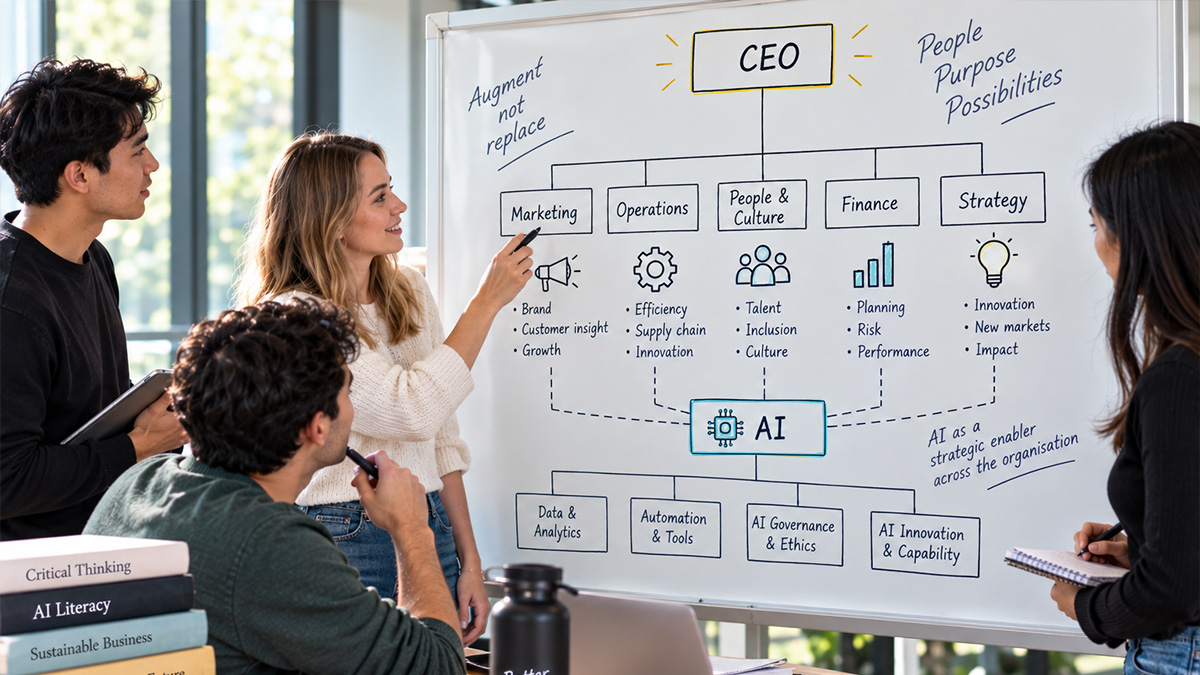
As generative AI changes how people learn and work, a UNSW Business School educator is exploring what it means for education, assessment and students’ workplace skills.
Associate Professor Lynn Gribble in the School of Management and Governance at UNSW Business School focuses on the impact of AI on education, particularly business education. Her work considers what AI means for education, how students learn and how educators can assess whether students can demonstrate that learning.
“The minute that ChatGPT became broadly available to everyone, I knew that the game had changed and there was no looking back,” A/Prof. Gribble says.
That shift raised questions about how generative AI (GenAI) could both support and obscure expertise.
“Not everybody is a great writer. Some people can be great at explaining, some are good at teaching, some are good at research – people have different strengths, and that shift enabled those who perhaps struggled to write to do so more easily,” A/Prof. Gribble says.
“At the same time, it allowed people who had little expertise to sound like they were really capable. That led me to go, right, so now we’ve got to really think about how we assess learning.”
Augmenting human expertise
A/Prof. Gribble uses GenAI across her own teaching and research, including to develop rubrics and procedures, check the coherence of teaching materials, review grammar and produce abstracts from completed papers. She begins with her own ideas and expertise before using GenAI to develop, organise or interrogate that work.
“You’re augmenting how you’re working because you’re bringing your expertise to sit both with and alongside this technology,” she says. “This allows me to do most of that base work quite efficiently, which then means I can spend a lot more time reading more widely on a subject and integrating those ideas into it.”
GenAI can also act as a critical reviewer, helping to interrogate completed work and check the central argument. She says this can prompt users to consider whether the technology’s interpretation reflects what they intended to communicate.
“It’s a good addition to the cognitive process. Do the machine and I agree about what I have been writing about?” she says. “Is the thesis clear, or have we met the criteria? All those things that you would ask a critical friend, you can now have a machine to help you do,” says A/Prof. Gribble.
Understanding how the technology works is an important part of using it effectively. She says users don’t need to become technical experts, but they need enough knowledge to understand the capabilities and limitations of the systems they are using.
“You’ve got to understand enough of the basics so that you’re not ‘wowed’ by what’s on the screen and that you understand what you’re asking GenAIto do,” she says.
Rethinking student assessment
The growing capability of GenAI has also raised questions about how universities assess student learning. Rather than designing assessments that exclude AI, A/Prof. Gribble argues educators should consider how students will use the technology in workplaces where it is likely to be readily available.
“If you really understand what you’re doing and you’re using GenAI well, then you realise there is literally nothing that is ‘AI-proof’,” she says. “Instead of worrying about AI-proofing assessment, we need to think about what the workplace looks like, and you will have AI.”
This doesn’t mean students no longer need foundational knowledge. A/Prof. Gribble compares disciplinary knowledge to learning times tables: people need to understand the fundamentals well enough to recognise when an answer doesn’t make sense, even when technology can provide that answer for them.
“We, as university staff, need to be making sure the students are learning the craft of the discipline and then how (Gen) AI works with that,” she says. “Every discipline has the times tables, or base learning.”
“Critical thinking is that ability to not accept something at face value, but rather to say, does that really make sense and to be sceptical of something,” she says. “Just because something’s plausible doesn’t mean it’s accurate and truthful.”
Bringing human value
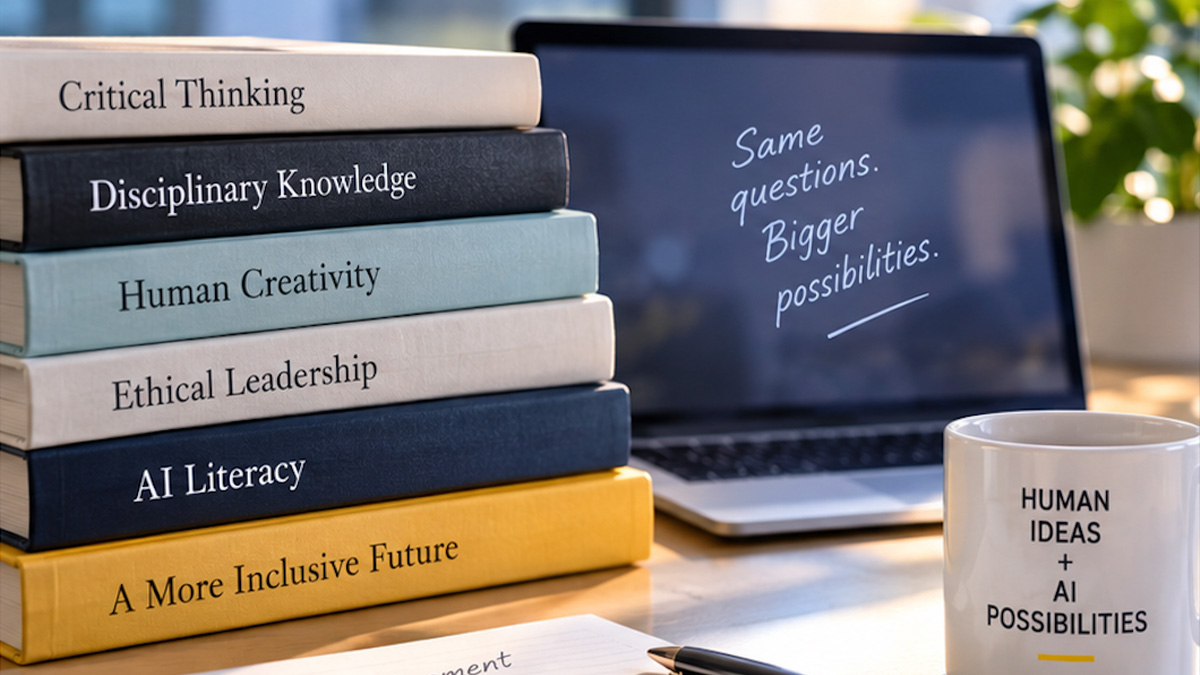
As AI is increasingly used to generate convincing content, A/Prof. Gribble says people will need to demonstrate the knowledge and experience behind their work.
“I think there’s an opportunity for people to be fraudulent in their claims and it’s going to take us longer to work that out,” she says. “Anybody can sound like they have expertise, and that’s going to mean that recruiters and anybody who’s asking any questions is going to have to be able to ‘dig’ around to understand their depth of knowledge.”
For students, this makes the knowledge and experience they bring to a problem particularly important. A/Prof. Gribble tells her students that reproducing information available from ChatGPT is not enough to demonstrate the value they can bring to a workplace.
“If you tell me what ChatGPT can tell me, why would I pay you?” she says. “I want you to bring your world experience and knowledge and understanding of the problem – and that’s uniquely human.”
Looking five years ahead
A/Prof. Gribble sees opportunities for GenAI to improve accessibility in education, workplaces and everyday life.
“People will still learn other languages, but the world will become smaller because everything will be able to translate in real time,” she says.
“We will see learning become very personalised, and perhaps the risk is that it becomes so personalised that we create a cohort of students who’ve never had to struggle, never had that moment of having to wait or take time to do something, or to work something out on their own.”
A/Prof. Gribble also sees opportunities for AI to support advances in areas such as health, mobility and more accessible ways of working. However, she says those possibilities need to be considered alongside unequal access to technology.
There is also the potential for misuse and its impacts on society. A/Prof. Gribble highlights the importance of maintaining human responsibility for how AI is deployed.
“We have to keep asking ourselves, is that the society we want to live in?” she says. “It is not a society that’s anti-progress, but one that still values humans, and we don’t give up human agency within it.”
For A/Prof. Gribble, AI ultimately remains a technology that people need to decide how to use. Its potential lies in what it can enable alongside human knowledge, creativity and judgement, rather than in removing people from the process.
“Human creativity is the one thing that machines can’t replace,” she says. “And so, together with AI, there is a really hopeful possibility for a future that we’ve yet to imagine.”
Photo source: Produced with OpenAI 11 September 2026.
- Log in to post comments