Understanding artistic and musical creativity using digital technology and its relation to society.
UNSW School of Art &Design’s Associate Professor Oliver Bown’s research interest in generative creative technology started around 2004. At the time, it was a far more speculative research topic, growing towards 2021 when a series of powerful tools and products became widely available. This changed the research landscape significantly.
“Suddenly the kinds of projects people were doing in a lab environment became things you could research in the ‘wild’, in terms of emerging cultures,” said Oliver.
Oliver’s research has followed that path and adapted to engage with the cultures of people using creative AI tools. Along with that is the relationship with policy frameworks, ethics and economics. This profound shift in creative culture and how it’s changed with AI has been dominated by large corporate platforms.
“Creative cultures are not just changing because people are using AI tools but because there’s a much more complex ecosystem of relations between creative communities, platforms and corporate power.
“For me it’s become the most important thing to focus on. We urgently need to look at the vibrancy, fairness and freedom of creative expression.”
When academic fields collide
With the massive transition to AI, a number of academic fields are grappling with the same challenges.
“It’s a wonderful era of academic disruption. Fields such as law, culture studies and engineering all have to work together on questions around AI ethics and creativity,” said Oliver.
“It’s an exciting time to be alive but there are urgent research questions that need answering. There’s a threat of companies stealing things of value from creative cultures and selling them back to them. This can be known as ‘intermediation’: the promise of technology cutting out the middleman flipped on its head.”
There’s a debate about whether AI copies from the training data it’s being trained on. A core theme of Oliver’s research is categorising what generative AI takes from its training data and how that’s understood by different stakeholders.
“When you train a generative machine learning system on existing cultural data and then use that system to generate outputs, do we see that as copying, being inspired or performing a type of mathematical operation?
“From high court judges to everyday artists, we must develop common concepts to understand what AI does when it learns. We tend to refer to known metaphors – inspiration and plagiarism. AI needs its own language.”
Navigating copyright in an AI world
One of the important strands of Oliver’s work is to look at the limitations of copyright. Copyright applies to private ownership of intellectual property resulting from a creative act. It necessarily excludes all the things shared in culture.
“When you think of a musical style like blues, there are lots of elements that nobody owns, like the sound of the guitar. Copyright is intentionally designed not to interfere with those things, they’re part of a shared culture.
“With AI companies training their generative AI systems, the question is, have they turned it into a new commodity and therefore we should rethink those shared cultural elements? There’s no easy answer to that. A large part of the AI music sector believes in doing the right thing and finding fair ways for AI to pay for its training data.”
But notable major players resist. OpenAI maintains that it doesn’t need to pay for the use of artists’ work in training. Oliver encourages staff to consider the moral dilemma around the use of other people’s work when using tools like ChatGPT.
“I think the individual shouldn’t be liable, but large corporations should be taking more responsibility. Criticism of OpenAI’s lobbying on copyright is important within the University when we’re paying for their services and using their tools.”
The impact of AI tools on creativity
Another strand of Oliver’s research looks at how AI tools impact a vibrant and flourishing human creative culture. Do these tools dampen creativity or enhance it? According to Oliver, it’s important to acknowledge there’s evidence on both sides.
“My recent research looked at creators who make music using the AI tool Udio. Although they might offload parts of the creative production, they still exhibit many positive traits in creative music engagement, especially as part of social communities.
“Some users go to great lengths to iterate and take part in interesting creative dialogues. They engage in shared creative cultures, sharing their techniques and riffing off each other’s work. At a social and cultural level these are hallmarks of creative vibrancy.
“The positive story here is that AI doesn’t necessarily dampen creative vibrancy – culture can live in creative AI practices. But that’s not necessarily thanks to these platforms, rather, in spite of them. We should still be very wary of the rising role of corporate platforms in creative cultures. AI’s de-skilling effect is part of this: platform dependency for cultural production is a serious concern. All the signs say ‘let’s get away from platforms’.”
Creative Technologies Research Lab
Oliver is co-director of the Art & Design’s Creative Technologies Research Lab with Dr Patricia Flanagan. The lab has a proud history of practice research where creative making is an important form of research.
“The lab has grown to incorporate sociological research perspectives – we’ve begun to look at how people are using creative AI tools in their communities. We couple that with our creative practice research which is more experimental.”
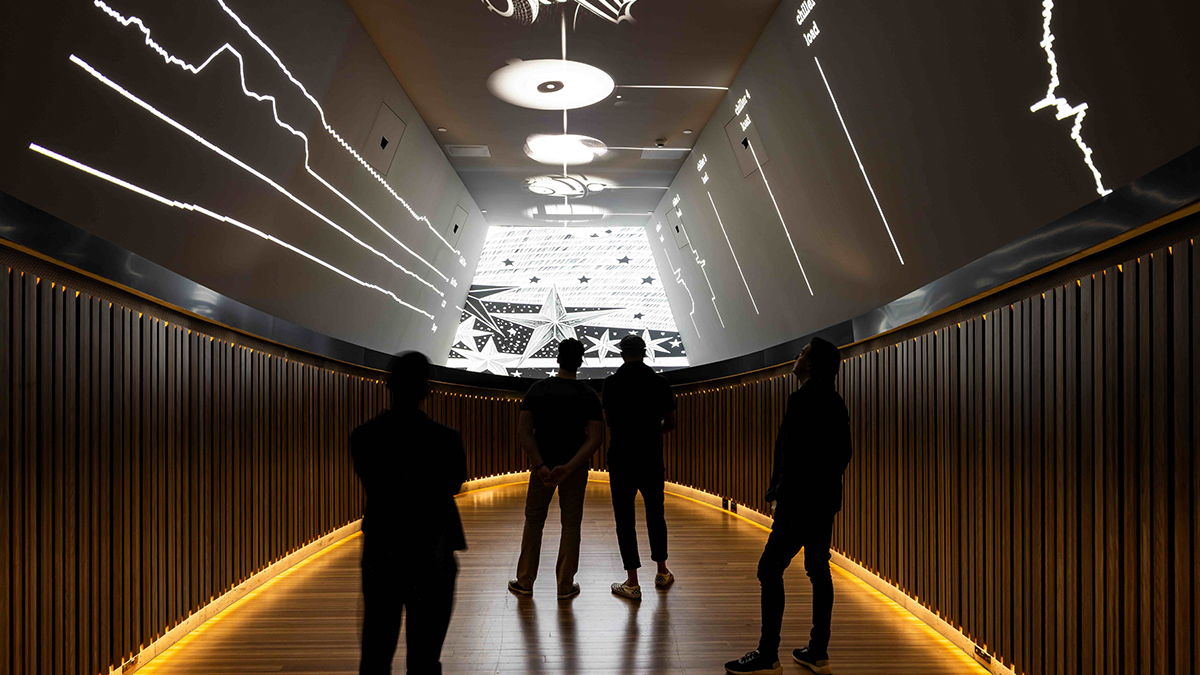
One of the creative projects Oliver worked on was a generative music piece for the Sydney Opera House. He looked at how AI can transform creative practice beyond simply subbing in for the creative process. The work took real-time data from the Sydney Opera House, like the building’s temperature, energy use, CO2 levels and event schedule, and interpreted the data via a large language model (LLM) to drive a real-time music system.
“This idea of LLMs being used in these roles isn’t about creating the work, but that they’re part of the work themselves. Their job is to turn data into music instructions. I think some of the best creative uses of AI are in this direction,” said Oliver.
Read more about Oliver’s work on AI music generators on the UNSW Newsroom.
- Log in to post comments