
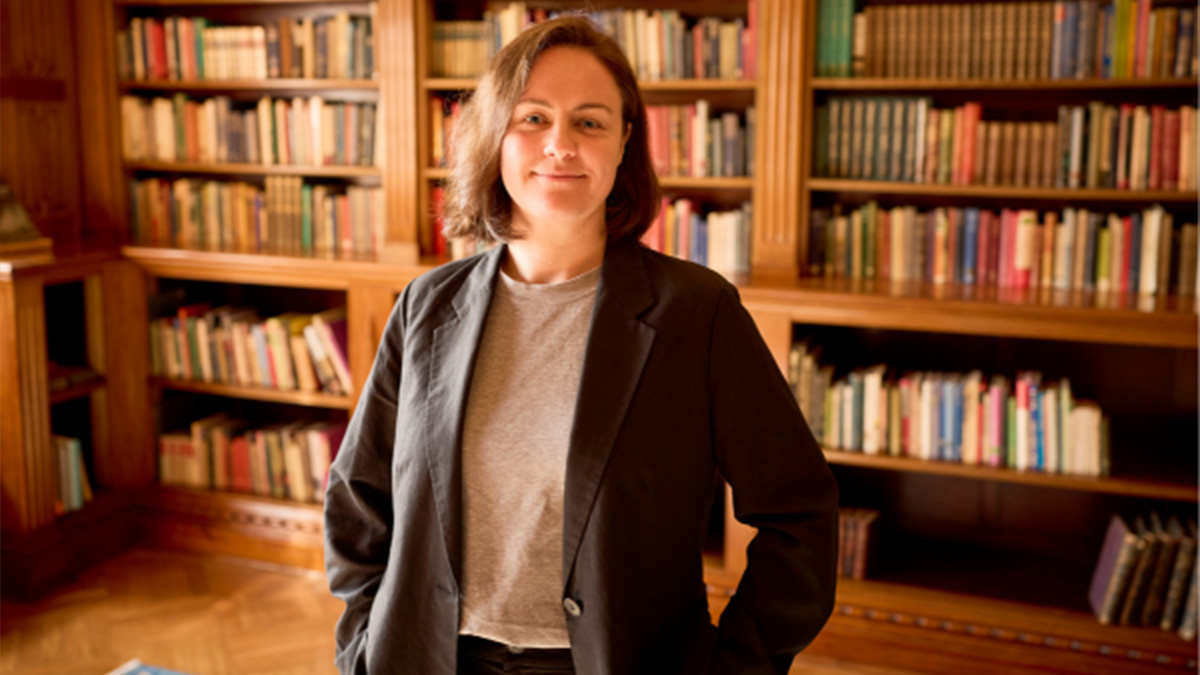
As AI becomes part of everyday services, a UNSW sociologist is examining how emerging technologies shape connection, inequality and community life.
Dr Ash Watson, a Senior Lecturer and UNSW Scientia Fellow at the Centre for Social Research in Health (CSRH) in the Faculty of Arts, Design & Architecture (ADA), is leading research on the social impacts of AI, funded by the UNSW-UTS Trustworthy Digital Society. She works with Dr Meherose Borthwick at CSRH, UNSW Scientia Professor of Artificial Intelligence Toby Walsh, Associate Professor Amelia Johns at UTS, and Professor Anthony McCosker at Swinburne University of Technology.
The team studies how AI affects communication, employment, access to information and participation in local communities. They also examine how digital change can deepen existing inequalities when communities fall short of the required skills and confidence in emerging technologies.
“It’s hard to think of a part of our lives that technology doesn’t touch anymore,” Dr Watson says.
Testing AI in libraries
The team works with the State Library of New South Wales and local libraries, which are integral to the research. Libraries are a melting pot bringing together people with different experiences, needs and levels of digital confidence. These communal spaces help communities access technology and navigate digital change, making them important settings for Dr Watson’s research.
“Public libraries are a really interesting context for this research. Technologies like AI are starting to change the role of the public library in our community, and what kinds of information and help people seek from them,” Dr Watson says.

Current fieldwork involves Bega Valley libraries, Fairfield City Open Libraries at the Cabramatta branch, City of Sydney libraries at the Kings Cross branch and Central Coast libraries at the Gosford branch.
In workshops, researchers introduce live speech-to-text transcription and translation devices. They observe how participants engage with the tools and invite group discussion about AI ethics, digital trust and the benefits and risks of emerging technologies.
“Contributing to public discussion and engaging with people in the course of their everyday life is something that's really central in my research.” Dr Watson says.
Libraries provide a level of insight into the exclusion that many people within the community face in the digital world. As more organisations adopt digital-first services, even a small gap in access can make essential information and support harder to reach.
“The front door to access is a digital one these days,” Dr Watson says. “The implications of being left behind, or people feeling less confident in their ability to keep up, are growing more serious.”
Learning from communities
Dr Watson’s qualitative research uses interviews, focus groups, workshops and in-person observation to understand how technological change affects people in practice. At a pilot workshop at Randwick City Library, Dr Watson met a man in his late 80s who had migrated from China and used AI on his phone for live translation and everyday conversation.
“It helped him have so much more confidence that he could just navigate his local community and talk to people and meet people and engage in ways that kind of blew me away,” Dr Watson says. “For other people, however, the rise of AI and the pace of digital change today is making them disengage from technology at quite a rapid pace.”
These experiences demonstrated why researchers need to examine both the benefits of AI and the ways digital change can exclude people.
Turning insight into action
The team aims to use the information collected from community experiences to inform how AI tools are designed and introduced, resources provided by libraries to address digital exclusion and how institutions respond as services move online.
The work done across libraries provide researchers the necessary information to identify and address obstacles that are shared across the spectrum. A multi-faceted approach treats the challenges as ones that anyone can face rather than as an individual problem.
“Digital skills are social skills. They’re things that we share. They’re things that we build up together,” Dr Watson says.
By connecting experiences across communities and library services, the project aims to identify practical ways to improve access, confidence and social equity.
- Log in to post comments