
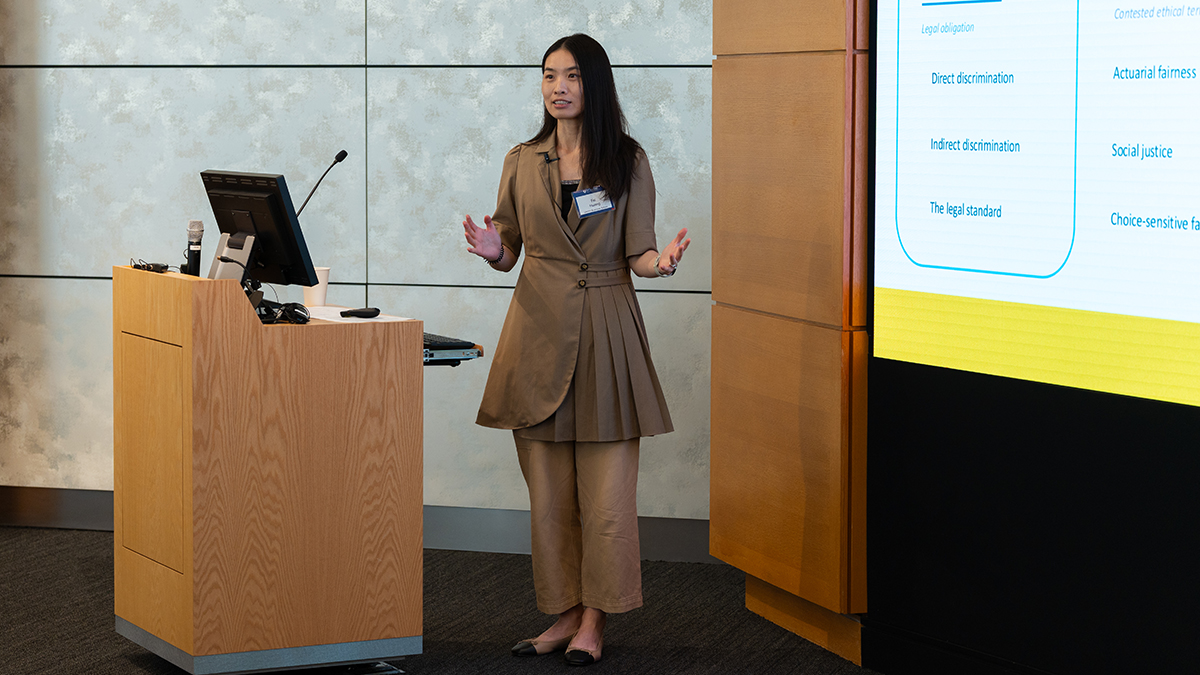
In an AI-driven world, impact comes from asking better questions, rethinking how students learn and bringing research, education and industry closer together.
The work of Associate Professor Fei Huang in the School of Risk and Actuarial Studies spans three connected pillars: education, research and industry engagement. Across all three, AI has prompted her to rethink how the profession works and what people need to thrive.
Preparing students for an AI workplace: the “cognitive gym”
AI has prompted A/Prof. Huang to rethink three fundamental questions in education: what we teach, how we teach and how we assess.
In the age of AI, universities need to build students’ disciplinary knowledge while developing their judgement, discernment, communication, leadership and interpersonal skills.
“The bar for graduates is higher. They need to lead, even when they aren’t managing people. They will be leading and managing AI systems,” said A/Prof. Huang.
With AI generating an abundance of possible answers, students need to know how to evaluate them and decide which are fit for purpose.
“We are no longer hungry for answers – often, we have too many. The important skills are judgement, discernment and taste.”
A/Prof. Huang calls her classroom a “cognitive gym”, where students build the judgement muscles they need to assess AI outputs and make responsible decisions.
“Students don’t come to my classes simply to receive information. They come to practise judgement and critical thinking, so they keep building the skills that will set them apart in the future.”
Her teaching uses interactive learning built around real-world challenges. She brings industry problems into the classroom through group assignments and the Industry Datathon, where students work on real challenges set with multiple industry partners.
“By working on problems the industry hasn’t yet solved, students can take their ideas into the workforce and make a difference. The classroom becomes more like an internship or workplace, helping prepare them for roles that are being redefined the age of AI.”
A/Prof. Huang draws on her research to shape her teaching. This term, she developed a new quantitative responsible AI course that helps students build skills in fairness, transparency and AI governance.
Creative learning through music
AI has also helped A/Prof. Huang find new ways to engage students. Using AI tools, she created Teaching in Tune, a collection of nine songs, one for each teaching week of her actuarial data science course.
“Each song captures the key concepts from the week and plays during class breaks to help students remember the material.
“Students love them. The key ideas are in the lyrics, so the songs make the content more memorable and enjoyable.”
Making AI fairer in insurance
A central question in A/Prof. Huang’s research is how insurance, superannuation and retirement income providers can use AI to deliver services that are efficient and accurate while also fair, transparent and accountable.
“These industries have all been influenced by AI,” said A/Prof. Huang. “Adoption is not only about whether we can predict something more accurately. It is also about whether the solutions are fair, accountable and explainable. That is the responsible side of AI.”
Many challenges associated with AI aren’t new. Discrimination and fairness have long mattered in insurance and financial services.
“AI does not necessarily create a new problem, but it amplifies existing ones,” said A/Prof. Huang.
“In my core research, I’m trying to bridge this gap and work with regulators and industry on more effective and resilient solutions.”
A/Prof. Huang’s research brings together insurers, professional bodies, government agencies, regulators and international organisations. In 2026, she co-chaired the Responsible AI and Analytics for Insurance workshop at the Wharton School at the University of Pennsylvania in Philadelphia with Professor Giles Hooker. The workshop brought regulators, practitioners and academics together to discuss fairness, accountability, climate and affordability in insurance.
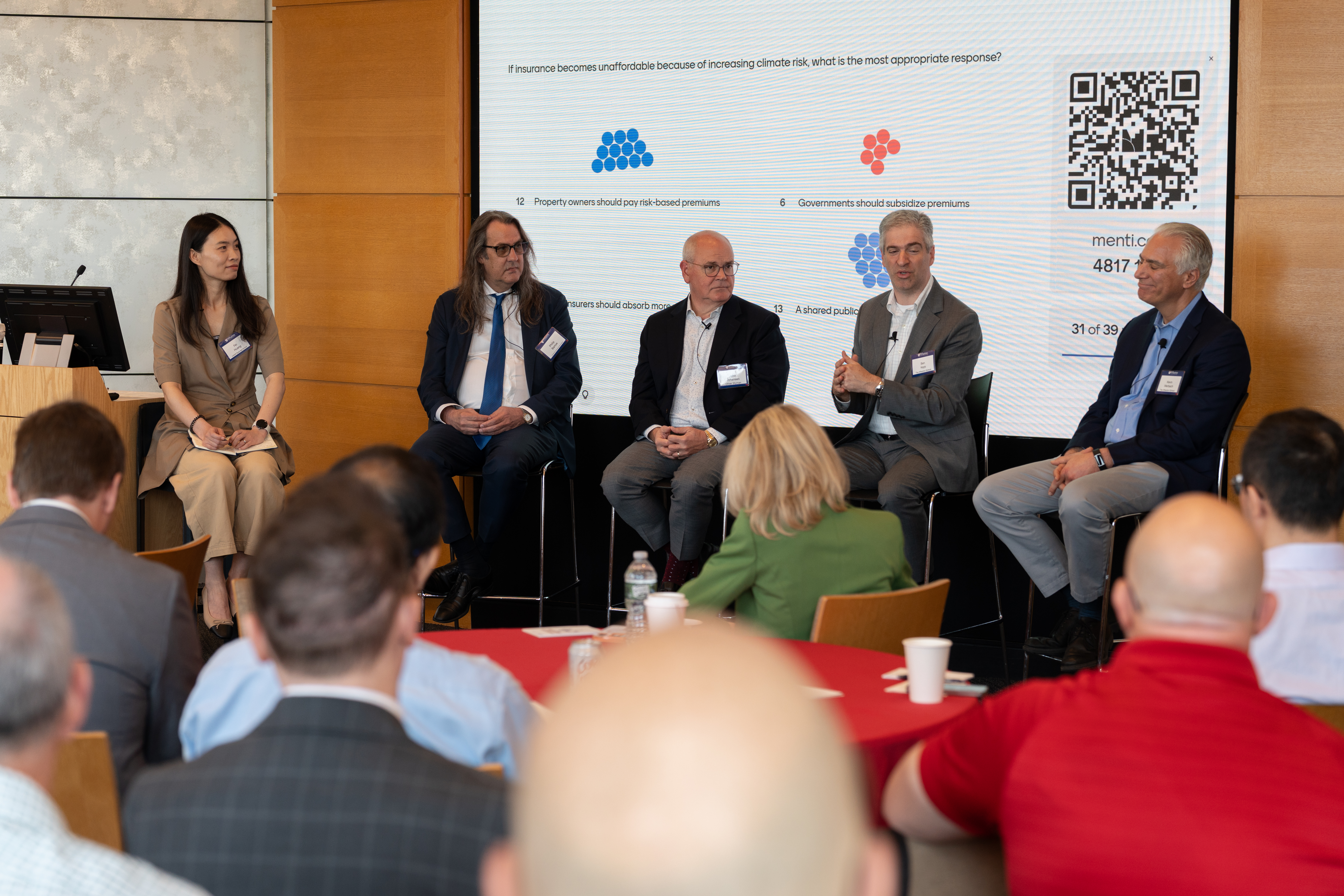
Associate Professor Fei Huang co-chairing the Responsible AI & Analytics workshop at the Wharton School.
Earlier, she worked with the Australian Human Rights Commission and the Actuaries Institute to develop guidance on AI and discrimination in insurance pricing and underwriting. Its aim is to help prevent discrimination when AI is used in these decisions.
More recently, A/Prof. Huang worked with Milliman and the Society of Actuaries in the United States on a project developing fairness metrics for life insurance. She also provided testimony to a New York State public hearing on AI for insurance underwriting and pricing.
“I value working in multidisciplinary teams. We bring different methods and experiences to important problems, and I’m a question-focused person. The right questions often need different perspectives,” she said.
Connecting research, education and industry
For A/Prof. Huang, industry engagement connects closely with research and education, and each informs the others.
She shares her research through academic publications, industry resources, public commentary, open-source tools and direct collaboration. Her work has also been covered by ABC, SBS and Forbes, and she has written for the Australian Financial Review and The Conversation.
“I’m also a columnist for Actuaries Digital, the Actuaries Institute’s magazine, where I write the Responsible AI series for industry professionals,” she said.
A/Prof. Huang has also presented her open-source Fair Pricing Playbook: Responsible AI for Algorithmic Insurance Pricing to members of the International Association of Insurance Supervisors (IAIS), which brings together insurance regulators from around the world.
“The playbook helps the insurance industry and regulators address fair pricing and mitigate indirect discrimination in the age of AI.
“It provides a practical, four-step approach to help insurers, actuaries, data scientists and regulators understand and manage fairness in algorithmic pricing. Sharing a practical resource is one way to engage with the industry.”
A/Prof. Huang led the development of the Australian Longevity Calculator, which helps Australians and the superannuation industry understand how life expectancy varies across socio-economic circumstances. The related policy paper, ’Bridging the Longevity Divide’, was published by the Actuaries Institute with co-authors Andrés Villegas, Francis Hui and Philip Clark and is helping shape industry practice.
“Engagement is not just about publishing a paper,” said A/Prof. Huang. “It’s also about providing frameworks, data and tools that help the public, industry and regulators make a difference.”
- Log in to post comments