
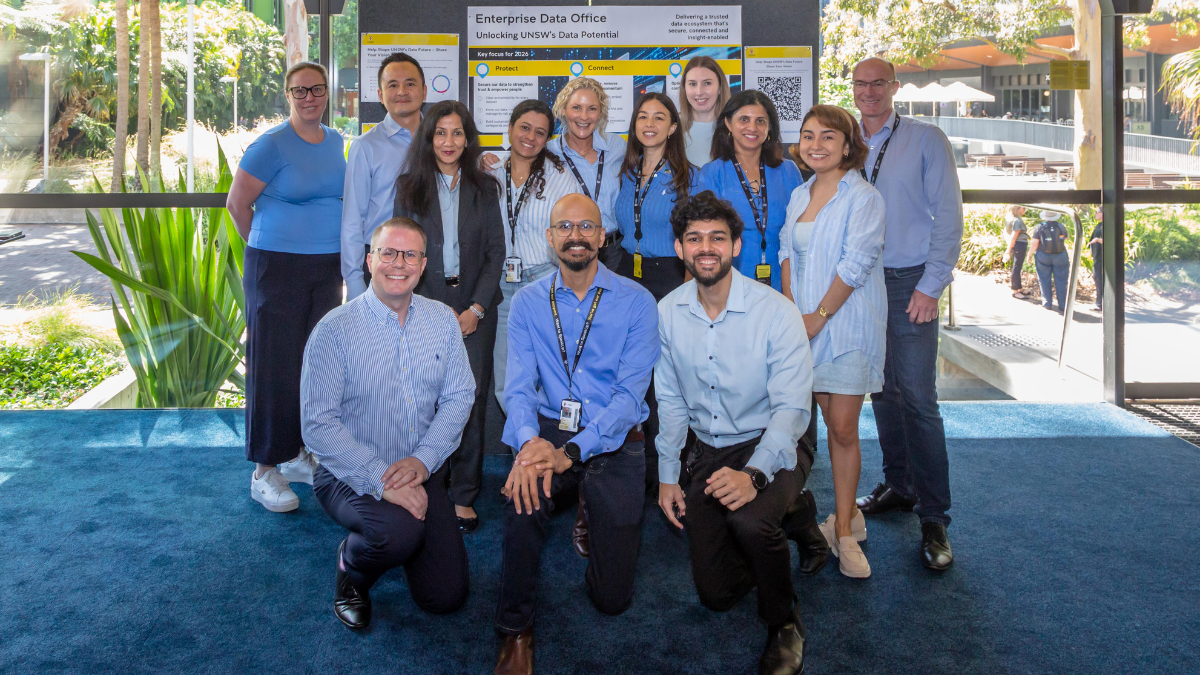
Our first Enterprise Data Office is here to unlock the power of data – secure, insight-driven and co‑created with partners across the University.
Since joining UNSW in April 2025 as Chief Data Officer, Surabhi Jain has been leading the creation of the University’s first Enterprise Data Office (EDO) – a bold step toward unlocking the full potential of UNSW’s data.
“UNSW does extraordinary work across teaching and research, and we collect enormous amounts of data along the way,” Surabhi says. “The EDO exists to turn that data into a strategic asset that supports this work across the University.”
Why does this matter?

Imagine using student and course data to improve the student experience or sharing research data with external institutions to solve complex global challenges. That’s the future EDO is enabling.
Universities generate vast amounts of data, but without strong governance and the right tools, much of it remains untapped. The EDO ensures UNSW’s data is high quality, secure and trusted. For initiatives with significant enterprise impact or data risk, EDO provides deep data expertise and University-level coordination.
Collaboration at the core
The EDO is building a central hub for collaboration and innovation, where staff can share data practices, replicate success stories and partner internally and externally.
“How do we learn from each other and scale what works across the University?” Surabhi asks. “And how do we partner externally to tackle shared challenges? Having data offices that can work together creates real leverage.”
From vision to action: Law & Justice success story
One of EDO’s first projects shows what this looks like in practice. The Faculty of Law & Justice needed a secure, streamlined way to manage expense reimbursements for external visitors. Existing processes were manual, inconsistent and raised concerns about data privacy.
EDO partnered with Finance and the Law & Justice to design and implement a customised digital solution that:
- captures sensitive information securely
- applies validation logic to reduce errors
- provides clear disclaimers to meet privacy obligations
- integrates with SharePoint for controlled document capture and storage.
The result? A trusted, user-friendly solution that improves efficiency and compliance – and can now be scaled across UNSW.
Beyond improving the process, the impact has been significant. By reducing manual handling, automating document management and strengthening validation controls, the solution has freed up effort equivalent to a full-time role — enabling staff to focus on higher-value activities while reducing administrative burden and data risk. This is a clear example of how EDO delivers measurable value to the University.
Three focus areas
Surabhi outlines three priorities for turning data into an asset at UNSW:
- Protect: Knowing and caring for the data we hold, through strong governance, privacy and security that build trust.
- Connect: Working together to build a data-aware culture, leveraging skills and expertise across the University.
- Unlock: Using insight, analytics and AI to drive better decisions and real impact.
The EDO team will provide training, tools and support, and build a network of data champions across UNSW to foster innovation.
Looking ahead
Looking ahead, the EDO will work closely with faculties and divisions across UNSW to shape a University-wide data strategy, informed by the needs and expertise of our community.
How do you get involved?
The EDO is here to help you unlock the power of data. Whether you’re automating a manual or risky process, looking to share or reuse a dataset, or wanting to build data capability within your team, EDO is your partner in creating a secure, connected, insight-enabled UNSW.
Ready to collaborate or have a data challenge the EDO can help solve? Email: edo@unsw.edu.au.
- Log in to post comments