
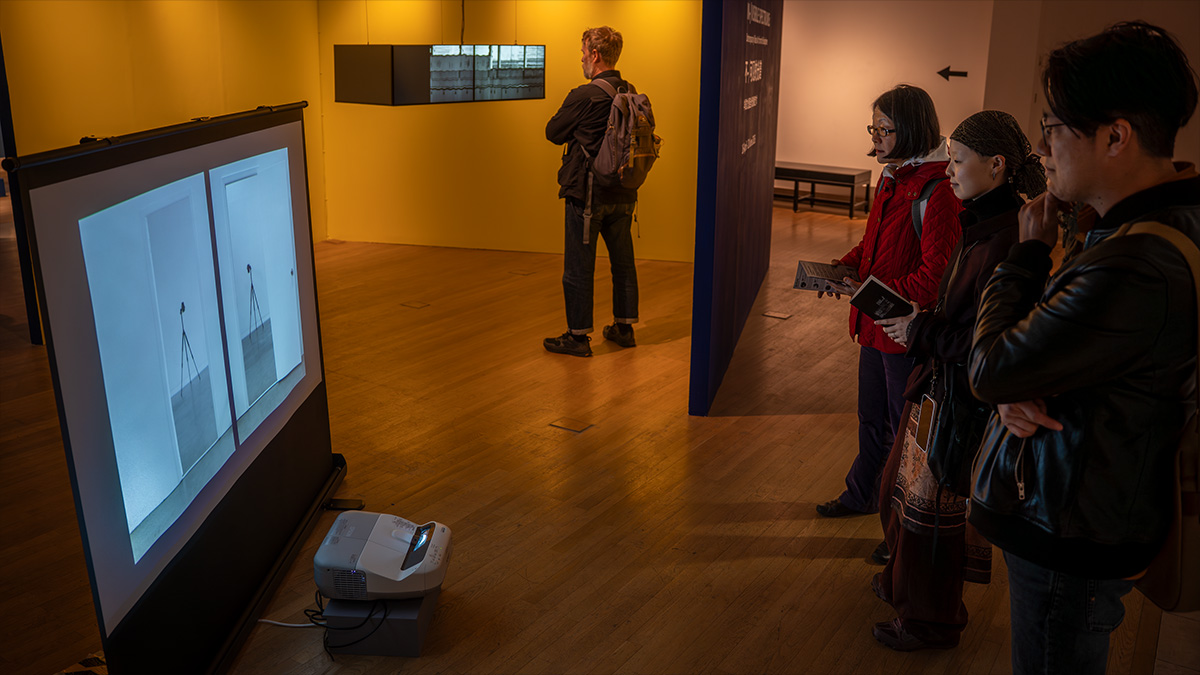
The exhibition provides visitors with an immersive experience featuring video artworks by 11 artists from mainland China, Hong Kong and the Chinese diaspora.
In-/Visible Spectrums: Contemporary Video Art from the Sinosphere (不-/可见的光谱: 华语文化圈当代影像艺术) is a major new research-led exhibition produced and financially supported by the UNSW Judith Neilson Chair of Contemporary Art (JNCCA).
The exhibition is open to the public until 20 June 2026 at the School of Oriental and African Studies (SOAS) Gallery, University of London. It opened on the 16 April, providing visitors with an immersive experience featuring video artworks by 11 artists from mainland China, Hong Kong and the Chinese diaspora.
Mapping contemporary video art from the Sinosphere: an international collaboration
Led by Professor Paul Gladston, UNSW Judith Neilson Chair Professor of Contemporary Art, In-/Visible Spectrums is the outcome of more than 18 months of research, international collaboration and creative transcultural exchange. Paul Gladston comments,
“This exhibition brings together a curatorial and project management team from Australia, China and the UK with artists living and working in various locations throughout the Chinese-speaking world,” Prof. Gladston said.
“It asks important critical questions about the global diversity of contemporary Sinophone identity as well as the varied conditions in relation to which ‘Chinese’ contemporary art is produced and received worldwide.”
Abstract, lyrical and poetic artworks in the exhibition highlight individual artistic voices emerging across the Sinosphere while also revealing common themes and cultural inheritances. All the works move between engagements with everyday experience and artistic experimentation. Many also intersect with lingering spectral traces of classical Chinese aesthetics (view the catalogue).
A key part of the project is captured in a documentary following a 2025 research journey across mainland China. During the trip, Prof. Gladston led a delegation, including co-curators Yique and Lin Zi, to Beijing, Shanghai, Hangzhou and Shenzhen, meeting artists in their studios and viewing works that later informed the final selection for the exhibition. Rather than serving simply as background preparation, the journey forms part of a broader inquiry into the ideological, institutional, cultural and sociopolitical conditions shaping video art practice in China today.
Multiple voices and engagements
For participating artist Zheng Xinhao, the exhibition offers an important opportunity to share work with new audiences internationally.
"In the current environment, your [JNCCA's] continued attention to and support for young artists from mainland China means a great deal to us. To be introduced to an international audience through such a thoughtful and meaningful exhibition is a rare and valuable opportunity, one that I deeply cherish," he said.
Alongside the exhibition is a public program of screenings, artist talks and panel discussions, which extend the critical conversation beyond the gallery space by inviting audiences to engage directly with the intentions, ideas and aesthetic practices behind the works.
Together, these encounters open up questions about relationships between artistic agency and social control that resonate strongly inside the Sinosphere and across national and cultural boundaries globally.
From gift to impact
The exhibition reflects the mission of the UNSW JNCCA, established through a $7 million endowment from philanthropist Judith Neilson AM in 2017, to deliver research, advocacy and teaching that foster knowledge and critical discourse about contemporary art in its diverse local, regional and global settings.
Caption: Photo © UNSW JNCCA, photographer Sunil Pun.
- Log in to post comments