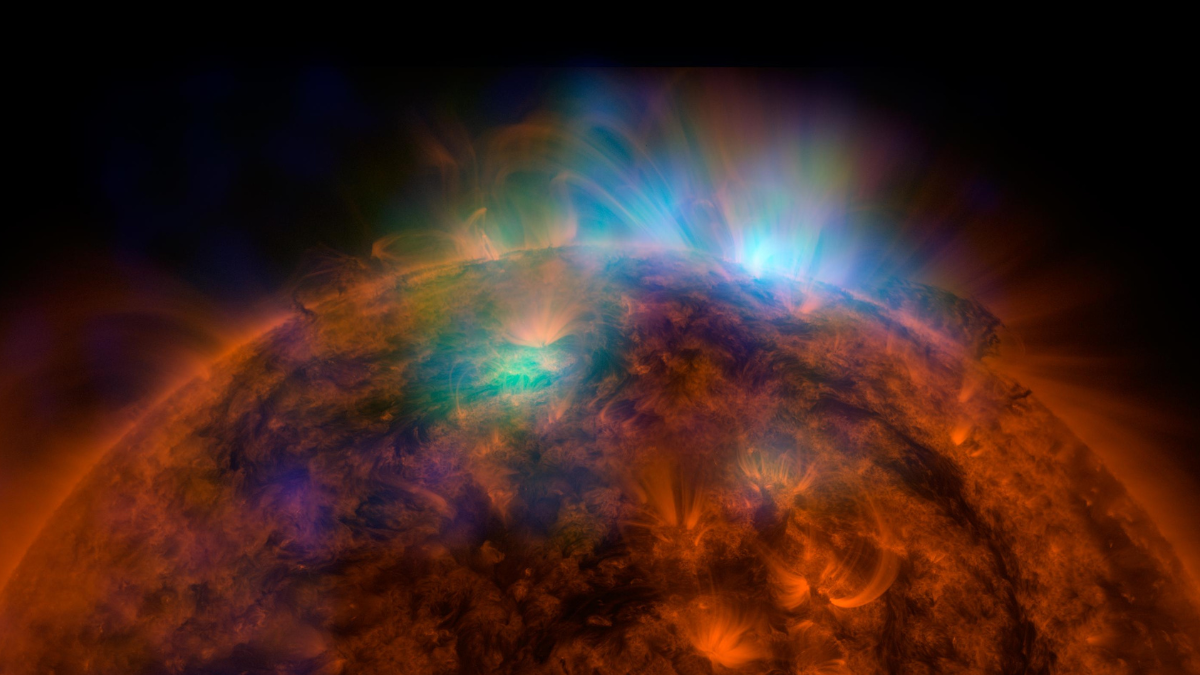
Professor Dennis Stello and his team in the School of Physics are developing AI software for studying stars.
The outer part of a star is essentially boiling hot gas. It's very turbulent, and that turbulence creates soundwaves that make the entire thing ring like a big bell.
Asteroseismology is the study of vibrations from starquakes. Soundwaves from starquakes travel through a star, and the paths of these soundwaves are influenced by local conditions such as temperature, density and chemical composition.
Astronomers can use starquake vibrations to infer information on the internal structure of a star, such as its density, temperature, composition, age and evolutionary stage. It’s similar to how geologists discover what’s inside the Earth by studying earthquakes.
With many millions of stars in the Universe, there is a lot of starquake data. That’s why Professor Dennis Stello and the Asteroseismology Group in the School of Physics are developing artificial intelligence (AI) software to analyse large complex data sets.
How are starquakes measured?
Although described as ‘soundwaves’, Dennis said we can’t actually hear starquakes from the Earth.
“We can’t hear the soundwaves because there's nothing between the star and us to let the sound travel. However, anything that vibrates physically expands and contracts, and that affects the brightness of the star.”
NASA space telescopes – such as Kepler and TESS – use electronic detectors called ‘charge-coupled devices’ (CCDs) to capture the changes in brightness.
“The raw data is basically an image like you take on your phone, however, there are stars falling on some of the pixels. You count how many photons – how much light – falls on that pixel during the exposure.”
The telescopes take images every few minutes for months or even years, which creates a time series showing how a star’s brightness changes over time. Astronomers then use a mathematical technique called ‘The Fourier Transform’ to turn this flickering light into a spectrum of frequencies – revealing the soundwave signals inside the star. These are the soundwaves used to map the star’s interior.
Where does AI come into it?
Using data collected from NASA space missions, Dennis and his team now have access to brightness measurements for millions of stars. What was once a data-poor field is now a big-data science.
“We went from working on single stars for an entire PhD to now having so much data we can't keep up. To analyse thousands and thousands of stars, we needed some sort of machine to help us out.”
Dennis’s team built artificial neural networks – a form of AI that’s good at visual recognition – to find patterns in the data that indicate starquakes.
“We got the AI to see which stars were creating soundwaves and put that data aside for us to examine. This weeded out about 90% of the data and provided us with the 10% we can use.”
He emphasised the benefits of using commercial general-purpose AI, like ChatGPT, in research contexts such as this.
“I was always very sceptical of AI and how reliable it is, especially with how often it hallucinates. However, the pro version of ChatGPT is a different beast altogether.”
Instead of churning out instant answers, the pro version works as a research assistant for Dennis, taking its time with prompts, citing its sources and producing quality content.
“Using AI now, I can ask the interesting science questions and let the engine do the boring part. I can verify all the references and save days' worth of work finding relevant literature. It's been a real gamechanger in accelerating the research process.”
Why do we want to understand stars?
Asteroseismology allows for the study very distant stars, which helps researchers understand the history and evolution of our galaxy – opening a new window on galactic archaeology.
“Stars are the dominant light source in space. We can use them as fossils of the Milky Way’s past, as they carry an imprint of the events that built the galaxy we live in today.,” Dennis said.
“Determining the ages and properties of stars is crucial for understanding how galaxies are put together. We can identify groups of stars that were born in the same place, trace their motions and reconstruct where they came from and how our galaxy formed.”
For Dennis, this mix of fundamental physics, AI innovation and cosmic history is what makes the field so compelling.
“In fundamental science, you're just looking for interesting things,” he said. “Along the way, you keep finding things and you must follow that route, because that's what’s interesting.
“It's all about following your nose to discover something new.”
- Log in to post comments