
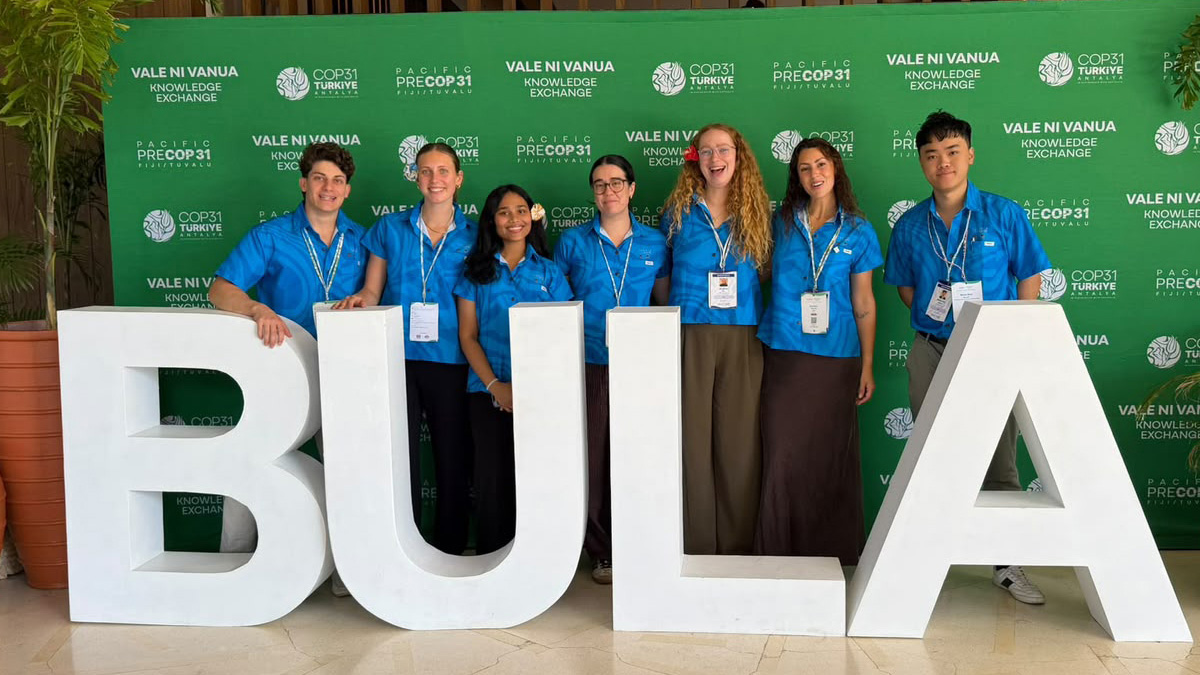
UNSW researchers and students worked with Pacific partners ahead of COP31 – from convening discussions that helped shape the negotiating agenda to supporting Pacific delegations in Fiji.
Three demands emerged clearly from the recent Pacific pre-COP31 discussions in Fiji – to keep the 1.5°C temperature goal alive, deliver sufficient finance for climate adaptation and to put ocean protection on the global agenda.
Before ministers and senior negotiators began those talks, the UNSW Institute for Climate Risk & Response (ICRR) helped convene a forum in which Pacific researchers, leaders and communities could define what those priorities mean.
Led by ICRR Research Associate Dr Wesley Morgan, 1.5°C to Stay Alive brought together Pacific and Australian researchers, ministers, policymakers, climate practitioners, artists and community representatives at the University of the South Pacific in Suva.
“Pacific countries played a key role in securing the 1.5°C goal in the Paris Agreement because, for the region, this is not an arbitrary number. It is considered a threshold for survival,” Dr Morgan said.
The forum was organised by the COP Universities Alliance and co-hosted by ICRR, the University of the South Pacific and the University of Melbourne.
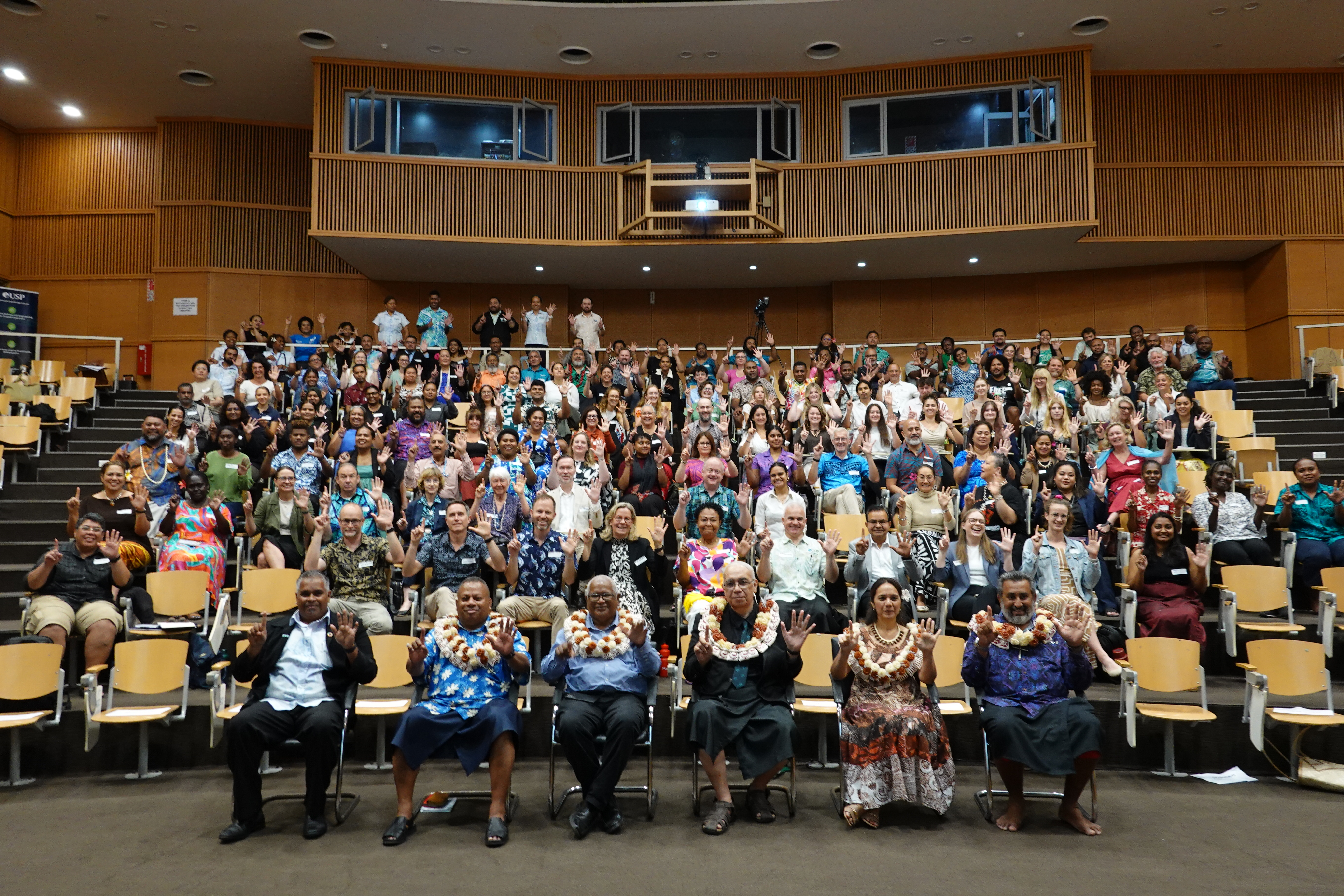
1.5°C to stay alive forum attendees (photo credit: Ilana Rigoni).
A condensed session opened the official pre-COP31 stakeholder program, carrying key themes directly into wider international discussions. The official gathering attracted more than 3000 participants, including senior ministers and officials from major negotiating countries.
The Pacific priorities will now help inform negotiating positions ahead of COP31 in Türkiye in November.
The survival of nations
For generations of Pacific islanders, the sound of the ocean has been a familiar and reassuring presence. But as Marshall Islands Climate Envoy and COP31 Regional Envoy for Oceania Tina Stege told the forum, “Hearing the waves at night was once a source of comfort. Now they are a source of fear.”
Her words captured how 1.5°C is connected to homes, livelihoods, health, cultures and the survival of nations.
ICRR Director Professor Ben Newell, who attended the forum and official pre-COP discussions, said the experience demonstrated why responses to climate change must be informed by more than scientific data alone.
One concern was the way temporary overshoot of 1.5°C is sometimes framed. The suggestion of temperatures being brought down ‘later’ implies communities and ecosystems could return to their former state.
Prof. Newell said that framing understates what could be lost forever.
“We cannot return to the same world after we overshoot,” he said.
While economic modelling can estimate the cost of damaged infrastructure, the loss involving culture, identity, health, community and connection to the ocean cannot be reduced to a financial figure.
Merging knowledge systems
The forum also looked at how traditional Pacific knowledge and Western science could be meaningfully integrated.
Coral Pasisi, Director of Climate Change and Sustainability from The Pacific Community (SPC), addressing the forum, said cultural knowledge acquired over generations – such as knowing which fish to target when teaching children to spearfish – is in many ways as valuable as having a PhD.
However, Prof. Newell said the world in which that knowledge was acquired is changing rapidly.
What are now familiar biological and environmental markers may change along with the climate, he said, which reinforces the need to strengthen regional research capability and place Pacific climate science in the hands of Pacific researchers.
From climate finance to practical action
Forum participants said the challenges go beyond attracting more funding to creating the mechanisms that suit small island states and deliver resources effectively.
During the wider pre-COP, the Pacific Resilience Facility reported pledges of US$118 million towards its US$500 million target. The Pacific-owned and managed fund is intended to direct finance towards community-level climate and disaster resilience.
Research led by Dr Morgan has also identified the economic opportunity in the region’s energy transition. Pacific island countries spend between 10% and 25% of their GDP on fossil-fuel imports, while replacing diesel electricity with solar and battery storage could save approximately US$700 million each year.
This work shows how climate action, energy security and regional resilience are inseparable – and how UNSW research can contribute practical evidence to international policy discussions.
While some public debate about the pre-COP focused on its cost and the number of world leaders attending, its importance will be measured by whether Pacific priorities influence the negotiations to follow.
Prof. Newell said his strongest impression from the forum and pre-COP was the way Pacific spirit and culture infused the scientific, legal and political discussions in an inclusive and good-humoured way.
He quoted a panellist: “We get frustrated, but we don’t give up.”
Students experience climate diplomacy firsthand
UNSW engagement at the Pacific pre-COP also gave seven UNSW Law & Justice students an opportunity to experience international climate diplomacy from inside the negotiations.
Invited to embed with the Fiji delegation, the students attended the stakeholder program and observed how Pacific nations work to focus international attention on the climate challenges they face and shape the global response.
Several of the students will continue to COP31 in Türkiye in November, where they will support delegations representing Pacific and other island nations during the negotiations.
The placements build on the last 12 months of work by the UNSW Centre for Sustainable Development Reform (CSDR) to support Pacific partners in developing Pacific-led responses to climate change and bringing them into the COP31 agenda.
Students attended side-events involving CSDR staff – including a session co-chaired by Arthur Sokimi (Pacific Regional Director of the Global Ocean Accounts Partnership, CSDR secretariat) on decarbonising Pacific shipping with the Solomon Island Maritime Authority. Another was on developing new regional finance models based on work out of the Niue NOW Trust with CSDR Director Eliza Northrop as a panellist, and CSDR’s Edoardo Santagata presented renewable energy monitoring and transition work underway with Tuvalu and Tonga.
These experiences connected the formal negotiations with the practical legal, reporting and policy work required to Ssupport Pacific responses to global climate and biodiversity challenges.
"What was made clear in Fiji is that Pacific countries are ready with working models developed in the region, not just asks or ideas. Solomon Islands has the evidence base for a cleaner fleet. Niue has shown how to fund ocean protection on its own terms. Now COP31 participants need to be ready to back them," said Eliza Northrop, Director of the UNSW Centre for Sustainable Development Reform.
- Log in to post comments