
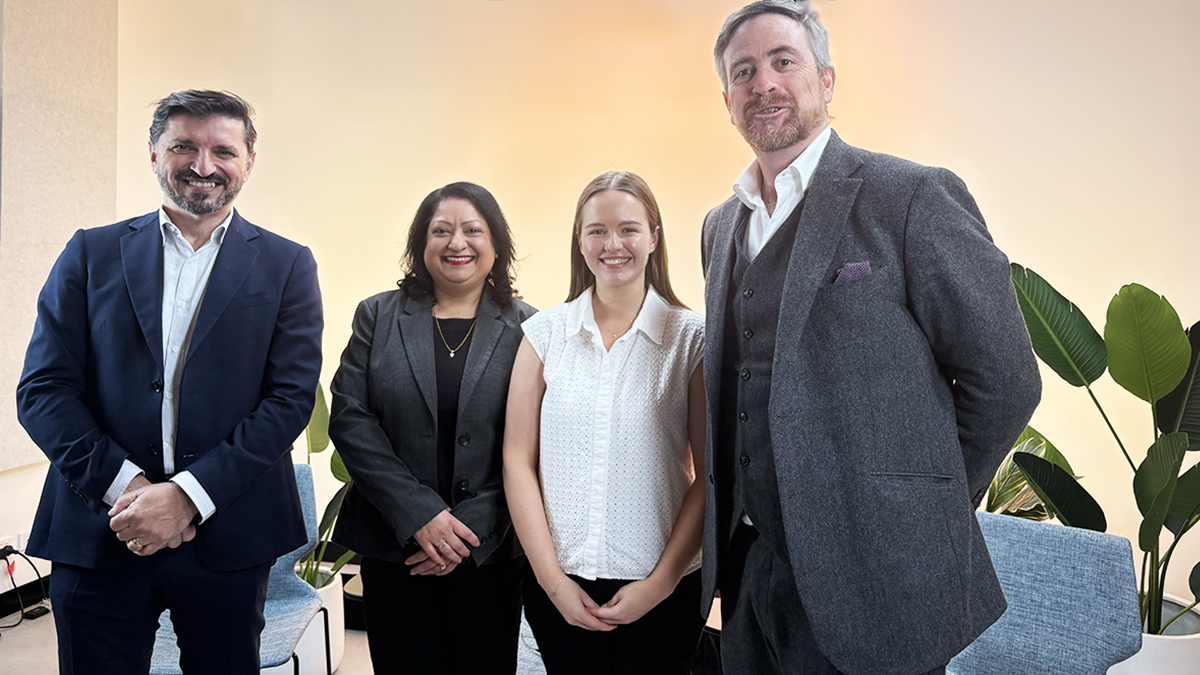
Close to 3500 UNSW staff joined a Town Hall on Monday 1 September, hosted by Vice-Chancellor and President Professor Attila Brungs, Provost Professor Vlado Perkovic and Executive Director, Strategy, Vinita Chanan.
The Town Hall included updates on staff awards and achievements; government relations; the University’s Chancellor Mr David Gonski AC stepping down; as well as the implementation of UNSW Strategy: Progress for All and the Academic Calendar.
PhD candidate Lilly Hatwell from Medicine & Health, who won the 2024 3 Minute Thesis competition, presented her work on the treatment of hormone-driven breast cancer.
The Vice-Chancellor's update
Prof. Brungs congratulated the winners of the 2025 Vice-Chancellor’s Awards and noted there was a record number of nominees this year. He also commended the winners of the Young Tall Poppy Science Awards, the AFR Higher Education Awards and nominees for the 2025 Eureka Prizes.
Now that construction has been completed on the UNSW Health Translation Hub (HTH), Prof. Brungs noted that this exciting milestone demonstrates UNSW’s strategy in action through our partnership with industry and government to deliver research and education that enable healthier lives.
“This world-class facility will enable our students to learn side-by-side with some of Australia’s brightest researchers, clinicians and health innovators, giving them unrivalled opportunities to engage in interdisciplinary education that has real-world impact,” he said.
Prof. Brungs shared an update on the University’s finances, noting that UNSW recorded a $200 million surplus in 2024 thanks to responsible financial management and prudent discretionary expenditure. This has been critical in weathering significant revenue uncertainty resulting from changing government policies and has contributed to our ability to invest in the physical and digital infrastructure we need in the absence of Commonwealth funding for education infrastructure.
Minimum annual surpluses of around $350 million are needed for the next few years to break even in the context of funding essential campus development work. This includes the replacement of ageing buildings across UNSW sites, building additional teaching facilities that support new approaches to learning, bare minimum expansion to meet demand for research facilities and building more affordable student accommodation.
Despite ongoing budget pressures, the Vice-Chancellor encouraged faculties to invest in necessary academic staff recruitment to ensure our student experience continues to improve.
The Vice-Chancellor spoke about government’s focus on reigniting productivity. He said that universities are critical for the discovery of new ideas and their application, which are both vital for sustained productivity growth.
“We hold the essential levers, first through cutting-edge innovation and research, and secondly through equipping the workforce. Universities hold the key to improving both labour productivity through increasing the capacity and knowledge base of the workforce, and multifactor productivity through innovating new technologies and improving the absorptive capacity of organisations.”
Prof. Brungs mentioned the Insight staff survey and work to address University-wide priorities that arose from the last survey, including the creation of the Innovation Working Group and an expanded leadership development program.
Finally, he announced that Mr David Gonski AC will step down from his role as Chancellor of UNSW at the end of 2025.
“David has been invaluable in navigating defining moments such as the COVID pandemic, complex government reforms and strategic decisions that shaped the University’s future, and in ensuring the University’s success for the next generation and beyond.”
UNSW Strategy: Progress for All implementation
Vinita Chanan, Executive Director University Strategy, shared how the University is turning vision into action through the planning and delivery of our new strategy.
She reflected that the strategy development process last year was a truly collaborative experience with extensive engagement from across the University community. Key insights from the process were distilled into Progress for All and its flagship initiatives.
“We received close to 10,000 individual pieces of feedback through consultations with our staff, students, alumni, partners and the broader community.”
Ms Chanan outlined how the 10-year strategy will be delivered through three triennial plans to keep us on track and accountable over the strategy lifetime, with the Triennium One Roadmap (2026–2028) launched this year.
To bring the strategy to life, Ms Chanan showcased examples of work already advancing the nine strategic pillars. Under Pillar 1, a major transformation in accessible education will come with the launch of the new Academic Calendar in 2028. Other key initiatives include expanding our access programs beyond the Gateway schools programs and embedding the University’s Belonging Framework.
She highlighted that a key priority for the next three years is building the foundations and frameworks for an uplifted and integrated research ecosystem under Pillar 2.
“When it comes to knowledge creation and translation, a core objective is to create a research environment for excellence and to nurture future potential.”
An aspiration in the strategy is to deepen our partnerships and networks. Ms Chanan pointed to the development of the Societal Impact Framework (SIF) and the UNSW Innovation Hub as examples of this work.
“UNSW has always been a partner of choice for industry, government and other universities in Australia and globally. One of the initiatives tied to this is the development of a partnerships framework to provide data, tools and resources to assist you in developing partnerships.”
Ms Chanan emphasised that the success of the strategy will depend on the cultural environment in which it is delivered. Pillars 4 and 5 are driving this transformation by simplifying systems, modernising platforms, and embedding a culture of trust and empowerment.
She concluded that 2025 is a foundational year for the strategy, with operational planning to be followed by ongoing ideation in partnership with the University community. Staff wanting more information can visit the newly developed Strategy Implementation SharePoint site.
Academic Calendar
Prof. Perkovic updated staff on the Academic Calendar project and the new flex-semester model, which was announced in April this year after extensive consultation.
He said the calendar is designed to enhance student experience and wellbeing, and will support staff as we deliver on UNSW Strategy: Progress for All.
“We are now focussing on implementation planning. Over the next two and a half years, we will work with the UNSW community to prepare for the 2028 flex-semester calendar to make sure we’re ready across all areas, including learning, teaching and operational systems.”
Key themes and considerations for the transition and implementation of the flex-semester calendar include the opportunity to reimagine our curriculum, teaching spaces and systems. They also include the importance of support to manage workloads during the transition and the need for a coordinated approach across the University to ensure alignment with our strategy.
Prof. Perkovic said the next steps in implementation include teaching space planning, co-designing the curriculum transformation approach, planning calendar dates for communication with students and ongoing staff engagement.
He encouraged staff to visit the Academic Calendar website to explore FAQs and key project information.
Q&A
The Town Hall closed with an opportunity for staff to ask questions. They submitted a number of questions and comments, which covered topics including measuring productivity, AI, onboarding to promote cross-collaboration, refining UNSW’s governance model, the Asian Century and the Academic Calendar.
Responses have been sent to individual staff members who asked questions.
- Log in to post comments