

Dear colleagues
My apologies for the delay in last week’s Inside UNSW. I was struck down by a nasty illness midweek, and I also wanted to wait until the government’s allocation of domestic and international student places for 2026 was communicated to us, so that I could share any financial implications with you.
The good news is that the allocations, and the buffers around them, will allow us to get close to our anticipated revenue for next year.
Thus, while budgets will remain tight for the next few years, particularly given the necessity to support the self-generation of operating surplus required to fund our significant 10-year capital program to better support students and staff with much-needed new spaces and repairs to our ageing infrastructure – we’re in a sound position and able to sustainably implement our strategy.
This means we will still not require any additional cost-saving initiatives beyond our usual prudent financial approach. This is in contrast to many other Australian universities weathering financial difficulties due to policy decisions such as the capping of international students and long-term declines in per-student funding levels.
I am mindful of recent media coverage highlighting the financial challenges across the sector so, repeating what I said at the recent Town Hall, I reassure colleagues as we head towards the end of the year, UNSW’s financial outlook for 2026 remains secure.
Again, as I asked at the Town Hall, please continue to be mindful of our discretionary spending and exercise fiscal restraint. Avoiding the usual uptick in December spending can have a real impact on the tightness of our budget in the next year or so.
UNSW Productivity Showcase at Australian Parliament
It was a great privilege to host the UNSW Productivity Showcase at Australian Parliament House earlier this month. The event brought together UNSW’s world-class researchers, educators and innovators with our nation's leaders and policymakers, demonstrating how UNSW is uniquely positioned to support Australia’s productivity agenda. The showcase featured researchers with world-leading expertise in fields critical to Australia’s future including energy storage, cybersecurity, AI, entrepreneurship, advanced manufacturing, housing, dementia prevention, tax, cancer survivorship and many more. These areas align with the government’s national productivity priorities and UNSW’s mission to drive positive societal impact and progress for all.

Federal Minister for Education Jason Clare highlights the pivotal role of universities in
driving national progress during his opening address.
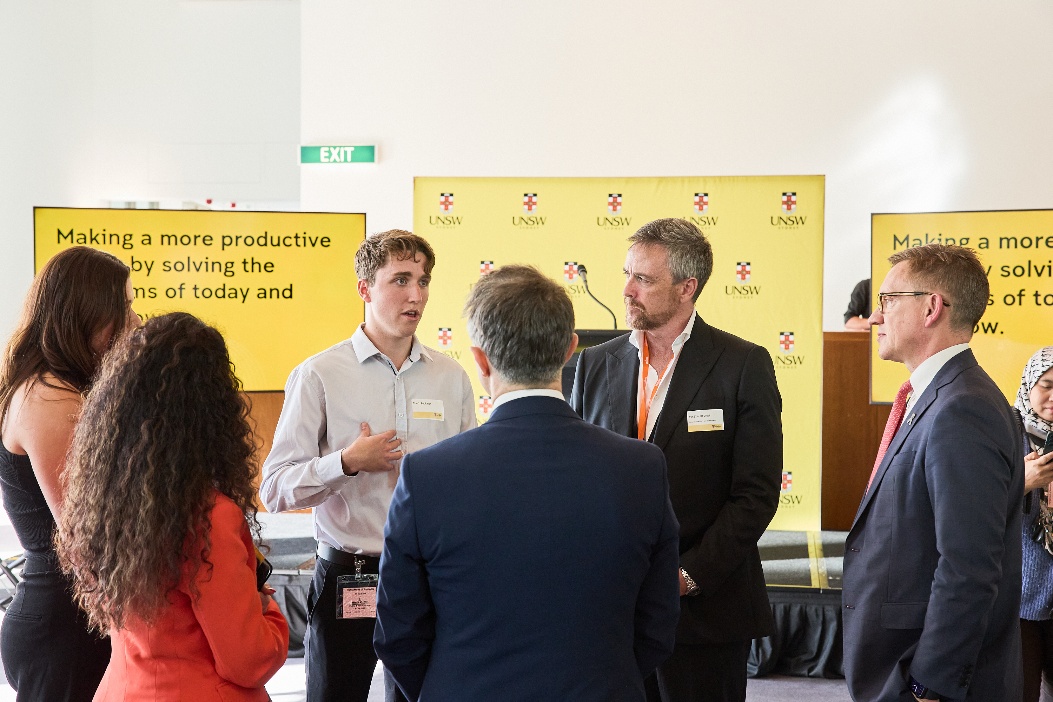
UNSW Mechanical Engineering student Chad Buckman, speaking with UNSW Vice-Chancellor Professor Attila Brungs and Education Minister Jason Clare.
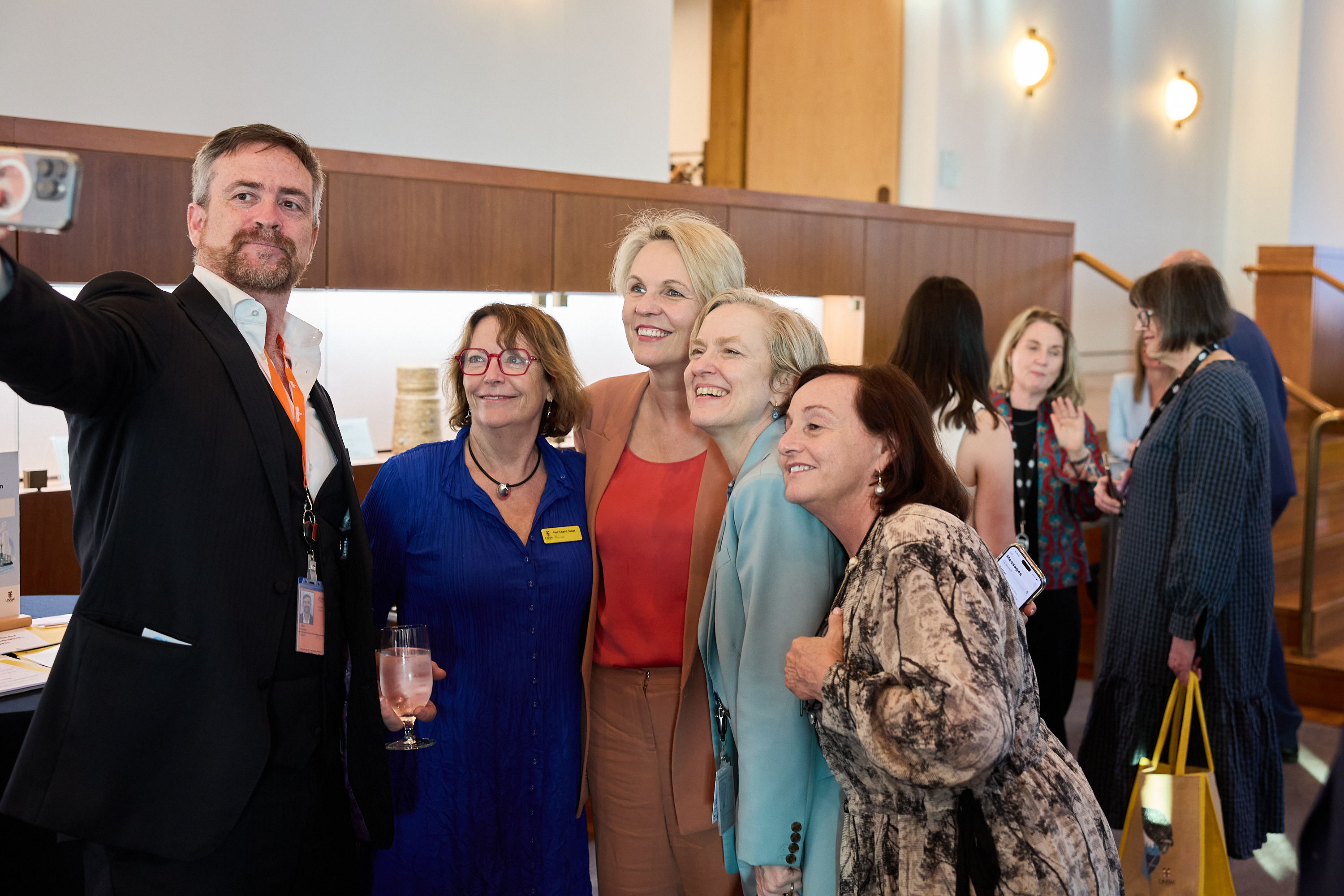
Vice-Chancellor Professor Attila Brungs with Dean of Medicine & Health Professor Cheryl Jones, Minister for Social Services Tanya Plibersek, Vice-President Societal Impact, Equity and Engagement Professor Verity Firth and interim Co-Director of UNSW’s International Centre for Future Health Systems Professor Patricia Davidson.
The energy in the room, the depth of engagement and the genuine enthusiasm for collaboration highlighted the vital role of universities, industry and government working together to translate research into real-world impact. It’s through these partnerships that we can lift labour and multifactor productivity, strengthen Australia’s economic and social prosperity, and ensure the benefits of innovation are shared across society. The event follows a successful showcase at NSW Parliament House last month. Federal Minister for Education Jason Clare spoke eloquently to the critical role of universities in his opening address inspired, as he said, by the conversations and people in the room. Thank you to the amazing academic colleagues who shared their expertise, our two wonderful engineering student speakers and the Government Relations team who organised these two outstanding events. Read more on the UNSW Newsroom.
Pictured top L-R: Dean of Law & Justice Professor Andrew Lynch, Professor Verity Firth, Head of the School of Law, Society and Criminology Professor Lyria Bennett Moses, Independent MP Allegra Spender and Vice-Chancellor Professor Attila Brungs.
Triennium One Roadmap is here
Today I’m pleased to announce the launch of our Triennium One Roadmap (2026–2028) – which sets out the University’s key initiatives for the next three years to advance our UNSW Strategy: Progress for All.
While the strategy sets our 10-year ambition, our first roadmap sets a clear path for the next three years, outlining the shorter-term vision for each Strategic Pillar and the key initiatives we will prioritise under each pillar to get us there. Many of these initiatives are well underway, and others are in development.
The initiatives are wide-ranging, reflecting the breadth of what we plan to achieve in the next three years across education, research, partnerships and societal impact. While our Triennium One Roadmap won’t capture everything we will do, it shows where our energy will be focused to deliver real impact.
I’d like to thank everyone involved in the creation of our Triennium One Roadmap. It has been a tremendous collaborative effort among pillar leads, deputy leads and staff across the University, led by the Strategy Office and University Planning and Performance (UPP) teams. Read more about the Triennium One Roadmap here.
UNSW rises to 79th in THE World University Rankings
UNSW has risen four places to rank 79th in the 2026 Times Higher Education World University Rankings. It is now fifth in Australia and one of only six Australian universities in the global top 100. The rankings assess more than 2100 research-intensive universities worldwide, based on teaching, research environment, research quality, international outlook and industry engagement. THE is the most survey-based ranking asking academics and others across the world their perspectives on universities. The improved ranking hopefully reflects the increased positive reputation that UNSW’s continued focus on high quality, student-centred teaching and research that drives real-world impact has had. Regardless, the fact that we are in all rankings one of the top universities in the world is a positive reflection of the unremitting focus on excellence of our people. Read more in this edition of Inside UNSW.
Festival of Online Education
Earlier this month, I had the pleasure of representing UNSW at King’s College London’s inaugural Festival of Online Education, on a panel with Professor Shitij Kapur, Vice-Chancellor and President of King’s College London, and Dr Michael Crow, President of Arizona State University. Our session focused on the evolving role of online education and AI in a rapidly changing world — and the opportunities, challenges and imperatives it presents for universities globally.
It was clear from our discussion that while each of our institutions has taken a different path into online education, we are united by a shared belief that high-quality, accessible digital learning must be central to the future of higher education. We also have many similarities as we evolve our learning approaches, particularly online, in response to the opportunities of AI. At UNSW, our motivation has been to expand access, enable lifelong learning and meet learners where they are — a goal that resonates globally. I spoke about the importance of designing systems that serve diverse student cohorts while maintaining academic rigour and responsible use of emerging technologies including AI, and the potential risk to the sector if institutions fail to engage with these technologies ethically and strategically.
I left the event energised by the passion and expertise of colleagues across the UK and European university sector and inspired by the clear potential we have to shape a more inclusive and sustainable future for education.
UNSW adopts recommendations to update and enhance investment practices
In culmination of a 10-month student and staff open discussion on UNSW’s investment principles and approaches, the UNSW Council recently adopted all the recommendations from an expert review of the University’s financial investment policies and frameworks. This review was conducted by a specifically created Financial Investment Strategy Consultation (FISC) Working Group, established through an open EOI process for all staff in 2024. I would like to thank the two volunteer Co-Chairs, Scientia Professor Richard Holden and Mr Andrew Fellowes. The Working Group ran focus groups, online surveys and all student and staff communications to ensure the breadth of UNSW student and staff perspectives shaped their debates and recommendations.
As you will remember from my previous discussions on the topic, the aim of the consultation was to engage broadly with UNSW students and staff to debate and determine if and how UNSW’s investment guidelines should be amended.
The adopted recommendations clarify UNSW’s financial objectives and include an explicit commitment to increased transparency and a new ‘controversial weapons’ investment exclusion. The team are now working on implementation details. Read more in this edition of Inside UNSW.
I would like to again thank the members of the Working Group for their efforts over the last year on an important conversation. I also thank all the students and staff right across UNSW who generously took the time to engage, and contribute to getting this right.
James Thomas joins UNSW as Executive Director Strategic Communications
I’m pleased to welcome James Thomas as our new Executive Director Strategic Communications in the Division of Societal Impact, Equity and Engagement. James commenced on Monday 13 October. He brings extensive experience in journalism, political strategy and communications leadership to the role. As Executive Director Strategic Communications, he will play a key part in amplifying the University’s voice in shaping national conversations and supporting our efforts to address some of society’s greatest challenges. Please join me in welcoming James to UNSW.
There’s more to read Inside UNSW…
- This edition’s staff profile is of Dr Ben Montet, a UNSW Science Scientia Senior Lecturer and 2025 NSW Young Tall Poppy Science Award recipient, who researches the architecture of planetary systems at work and runs marathons in his downtime.
- UNSW’s 3DXLab is reimagining what’s possible in immersive AI-enabled 3D video with its state-of-the-art volumetric capture arena. Read more in AI Insider.
- Congratulations to Dr Shannon Pike, Dr Wentao Li, Associate Professor Gila Moalem-Taylor and Dr Faraidoon Haghdoost who have secured $4.7 million in Medical Research Future Fund (MRFF) grants for four projects aimed at improving patient care. They include new treatments for cluster headaches and complex regional pain syndrome, improved access to care for rural paediatric patients, and investigation into causes of pregnancy loss for those undergoing assisted reproductive technology.
- Congratulations to Professor Pall Thordarson and Professor Chuan Zha who have been recognised at the 2025 Royal Australian Chemical Institute National Awards for their outstanding contributions to chemical sciences.
- I would also like to congratulate Professor Adelle Coster and Scientia Associate Professor Matthew Baker who have been recognised by The Australian Society for Biophysics with top awards for their achievements in the field of biophysics.
Best regards
Attila
Professor Attila Brungs
Vice-Chancellor & President
- Log in to post comments