
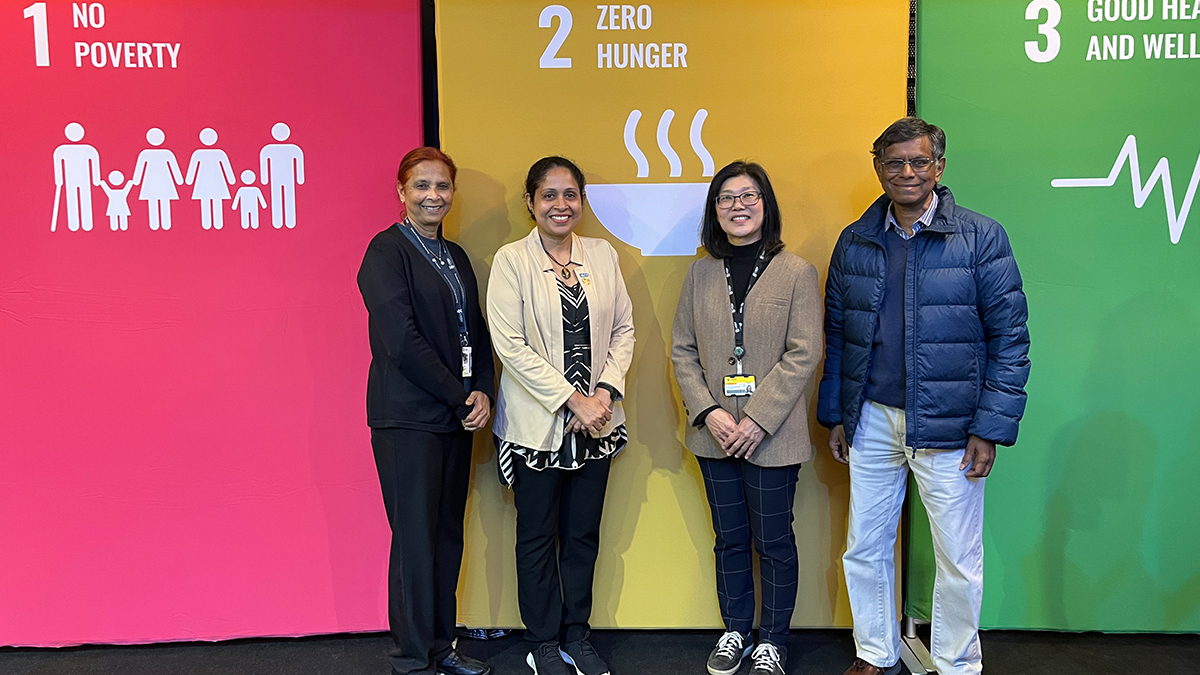
UNSW welcomed Dilka Rashmi Peiris from the World Food Programme in Sri Lanka through the 2025 Diversity in Engineering Academic Visitors Funding Scheme.
Food Science academics Associate Professor Alice Lee, Professor Jayashree Arcot and Adjunct Fellows Jay Sellahewa and Frances Warnock have collaborated with the World Food Programme (WFP) since 2023 through New Colombo Plan funding. A/Prof. Lee hosted Dilka Peiris, Policy Officer for Nutrition, at UNSW in October 2025 to collaborate with Food Science and Chemical Engineering academics.
Rebecca Martin, Manager Societal Transformation, spoke with Dilka about the partnership at UNSW’s 2025 SDG Showcase.
“Dilka has a background in food and nutrition and has worked across the development sector—including NGOs, government and academia—focusing on food security and community programs, This makes her an ideal collaborator for development-focused initiatives and to share insights with partners at UNSW,” said Rebecca.
World Food Programme’s work in Sri Lanka
The work of WFP Sri Lanka covers disaster response, recovery and development, including maternal and child nutrition programs, school meals and resilience building. The mission is to save and change lives, aligned with SDG 2 (Zero Hunger) and SDG 17 (Partnerships), and linked to other goals.
“WFP also strengthens systems and capacity by partnering with government, mobilising resources and supporting national initiatives like school meals,” said Dilka.
“For example, WFP funded staples such as rice, dhal, oil and dates for school programs. To promote sustainability, WFP launched the ‘Home-grown School Meal Programme’ enabling local suppliers to provide produce and access markets for surplus.”
Student engagement and collaboration
UNSW Food Science and Chemical Engineering students had the opportunity to contribute to the WFP through their studies and assessments. Seven UNSW students participated in WFP activities in Sri Lanka on nutrition and food safety projects.
The exchange was mutually beneficial and fostered two-way learning.
“Students gained experience in a middle-income country while contributing technical expertise and fresh perspectives, and WFP benefited from their knowledge and exposure to global practices,” said Dilka.
“Projects focused on improving school meal nutrition through rice fortification with iron and folate, assessing food hygiene among local suppliers, creating resources like a school meal safety pocketbook and monitoring aflatoxin contamination of corn used in manufacture of nutritious corn-based foods.”
Growing impact and future directions
The UNSW partnership has evolved into a broader collaboration involving research, local institutions such as the Sri Lankan National Food Promotion Board, and local universities. Plans include formalising and expanding efforts into water and food security, promoting youth engagement in aquaculture, and maintaining ties with government and academia.
Meetings at UNSW with Ms Peiris have focused on developing concept notes for future projects aimed at long-term impact in Sri Lanka, with potential private sector involvement and opportunities for Sri Lankan students to engage with UNSW.
Dilka said she was fortunate to participate in the 2025 SDG Showcase during her visit to UNSW.
“It was inspiring to see the breadth of UNSW’s work across all 17 SDGs. WFP’s work connects with many SDGs and events like this are important for sharing knowledge and building collaboration.”
To find out more about the UNSW collaboration with WFP Sri Lanka, visit:
- UNSW Food Science and Engineering
- Food Systems Innovation in Asia Pacific – UNSW forum for World Food Day 2024
- Sustainability in action: UNSW celebrates innovation at the SDG Showcase.
Photo top (left to right): Prof. Jayashree Arcot (UNSW), Dilka Peiris (WFP Sri Lanka), A/Prof. Alice Lee (UNSW), Jay Sellahewa (UNSW).
- Log in to post comments