
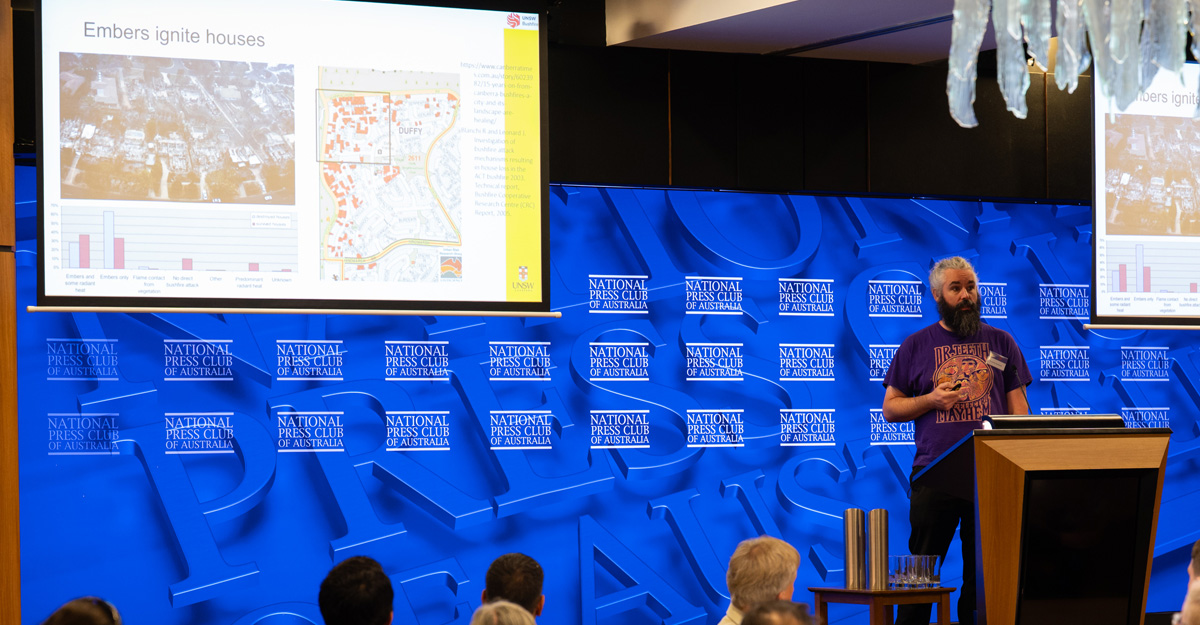
The UNSW Canberra senior lecturer’s research on ember dispersion uses equations to accurately model how a bushfire will spread.
Deputy Director of UNSW Bushfire and senior lecturer at UNSW Canberra Dr Duncan Sutherland is making a significant impact in the way we plan for development and prepare for fire season.
For his report to the ACT government, Ember storms at the rural urban interface, he used software to simulate fire behaviour in certain regions and provided recommendations to improve resilience. This work on the rural urban interface – also known as wildland urban interface – is relevant worldwide.
Duncan said he didn’t meticulously plan his career.
“I followed the people, I followed the job. Mobility or agility in academia are qualities that are very useful for a longer career,” he said.
A love of maths and making things
Duncan always had a knack for making things and an interest in understanding how they work. He completed a PhD in Applied Mathematics (vortex dynamics) at the University of Sydney.
Duncan describes vortex dynamics “as two-dimensional, spinny things in fluids, like a cyclone in the upper atmosphere”. While his research became “quite abstract, it always centred around fluids and numerical methods to solve fluid, dynamic problems,” he said.
Fluid dynamics is quite a broad area, as is computational numerical maths. So, when Duncan finished his PhD, he had “lots of options”.
“I’m a bit of a dilettante. I can get interested in various fields,” he said.
When Duncan saw an ad for a postdoc, applying computational fluid dynamics to bushfires at Victoria University (VU), he applied straightaway.
“It was an emerging area because there wasn’t much software available to predict how fires behave. It’s a complex problem, so it really intrigued me. Now, we can simulate the evolution of a fire based on the area it's in and the fuel sources available,” Duncan said.
Moving to UNSW and studying embers
After four years at VU simulating fire spread, publishing papers on grassfires and collaborating on projects involving merging fires, Duncan “followed the people and the work”.
“I knew Professor Jason Sharples, who’s head of UNSW Bushfire and I knew I was aligned with the work coming from that research group based in Canberra,” he said. So, when a role at UNSW Canberra came up, Duncan applied.
Duncan’s research now focuses on ember behaviour.
“Embers cause about 90% of house losses in a bushfire. We used to think they flew long distances and landed on roofs, but what we actually see are great sheets of embers bouncing across roads and accumulating on houses,” he said.
His team’s simulations reveal that asset protection zones, designed to defend homes, can sometimes make ember storms worse.
“Forests block wind flow, slowing it down. If a forest is sparse and there is cleared land downstream, called an asset protection zone our simulations show that the wind will quickly re-establish downstream, so the embers can move quickly through that asset protection zone. That’s something planning and government will have to think about,” Duncan said.

Duncan discussing extreme fire behaviour with Alicia Payne MP, at the UNSW Productivity Showcase at Australian Parliament House.
Building partnerships after Black Summer bushfires
Duncan’s work doesn’t stop at theory. He has built strong relationships with end users, including the ACT Suburban Land Agency and the Emergency Services Agency.
“After the Black Summer fires of 2020, I applied for a grant to fund ember research and was fortunate to get it,” he said.
At the same time, Duncan reached out to contacts at the Suburban Land Agency who were concerned about bushfire risk in new developments and he was able to provide insights that influenced planning decisions.
One project involved simulating ember impacts on apartment blocks which researchers rarely study.
“We found that while the impact reduces with height, it’s still not negligible. We need to translate that into public messaging, like telling people to clear balconies,” Duncan said.
As bushfire seasons become more unpredictable, Duncan remains committed to using science to keep communities safe, finding ways to apply what he knows, to make a difference.
What’s might surprise your colleagues?
I was homeschooled. Until university, I didn’t have a conventional education.
What’s the best advice you ever received?
An academic career is a war of attrition. Your success isn’t about ability but often due to persistence and a willingness to be flexible in where you work.
What’s one thing that makes you happy?
I like making things. I get a buzz from figuring something out. I just made a set of knives because I’d previously made a belt grinder.
What day in your life would you like to relive?
I wouldn’t relive any day because you always want to move forward. It’s better that we accept the experiences we’ve had and look to learn and improve on them for the next experience.
What’s the best thing you watched in the last year?
A YouTube video of how to make a belt grinder.
- Log in to post comments