
Research using AI to analyse mass spectrometry datasets is paving the way for early disease detection from breath and blood samples.
UNSW Science Professor of Chemistry William Alexander Donald’s research uses mass spectrometry to find new disease markers, support drug discovery applications and to study how proteins behave and interact. Mass spectrometry is a technique that measures molecules, providing information about their identity, structure and abundance.
Since 2022, Prof. Donald and his team have been developing and applying interpretable AI methods to analyse complex metabolomic datasets that are generated by mass spectrometry.
“We use state-of-the-art analytical instruments to try and detect as many molecules [metabolites] as possible from a biological sample, such as blood,” said Prof. Donald.
“We are particularly interested in breath analysis which is a source of huge chemical complexity. There are up to 2000 different volatile organic compounds that can be measured just in someone’s breath.”
Leading the way with AI-powered breath analysis
Breath analysis research dates to the 1970s and has been used to detect many different diseases. But one of the key limitations of many of these studies is that the concentrations can be at low levels, parts per billion or parts per trillion. This means typical analysis methods require lengthy preconcentration steps.
“For example, you might need to breathe into a material for 15 minutes to an hour to obtain enough sample to analyse. Then the analysing can take up to two hours to do the full suite of experimentation,” said Prof. Donald.
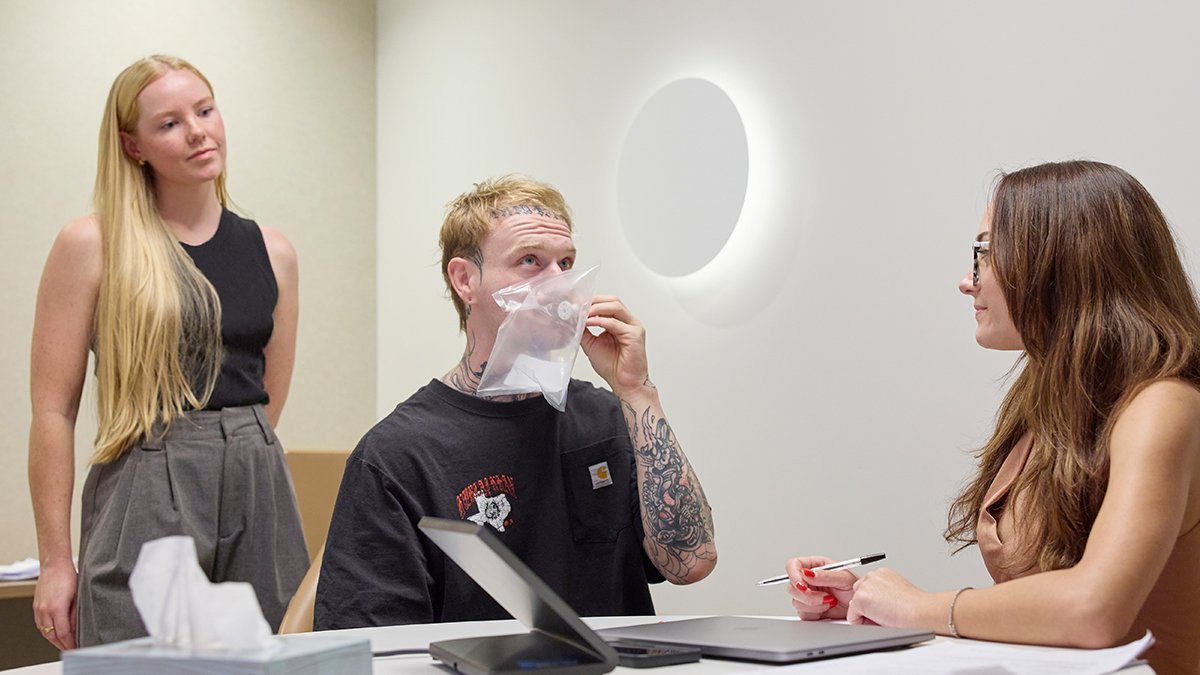
“We have developed a highly sensitive mass spectrometry approach that enables direct breath analysis without lengthy preconcentration steps. Measurement can be acquired within minutes.”
Unlike many conventional breath analysis approaches, with mass spectrometry, measurements can be obtained within minutes without lengthy sample preparation and analysis. The speed and simplicity of the approach make repeated sampling more practical, allowing researchers to track changes in an individual's breath profile over time and generate richer datasets for AI-based analysis.
The AI tool the team developed was built in-house and was used in an initial study for an AI-powered breath test designed to investigate whether breath analysis could identify workers at risk of silicosis before substantial disease progression occurs. It uses six different machine learning algorithms, including neural network and XGBoost.
“The AI tool goes through these really complex datasets with thousands of chemical features being detected. What’s really great about AI is that it can pick up subtle differences between datasets that the human brain wouldn’t be able to process and make sense of. There’s just too much data to comprehend,” said Prof. Donald.
“It can go through all this data, find relationships and classify it. The algorithm will find which of the chemical features in those datasets are contributing the most to an accurate prediction. This allows us to start to gain biological insights into what’s important for the performance of the prediction it can make.”
Ensuring AI accuracy to process large datasets
The research team uses AI all the time to process large datasets such as other published metabolomic studies that upload their data. The AI tool can be used to mine other researchers’ datasets. It has a lot of potential to find new information that may have been missed by using more conventional data analysis approaches.
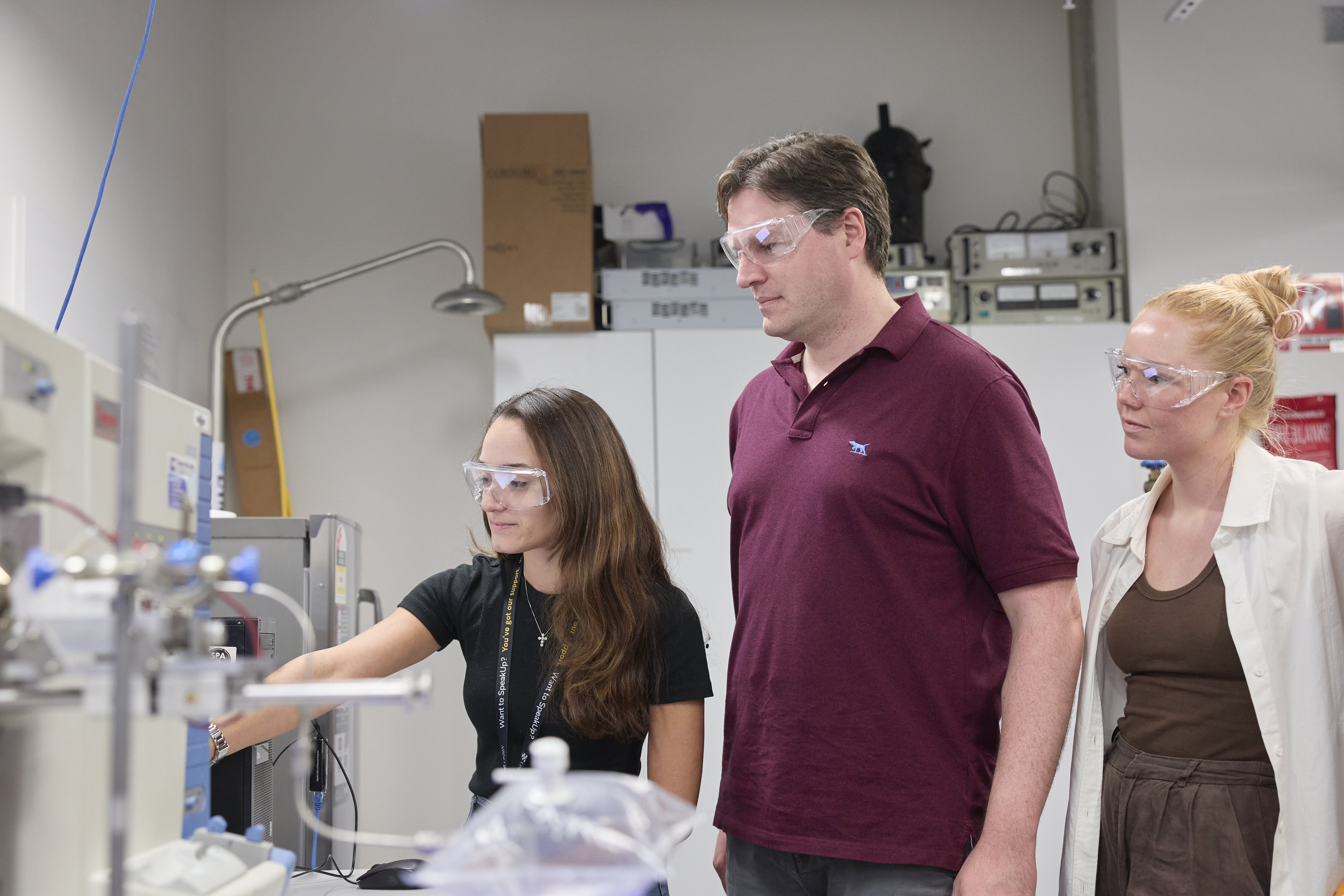
Professor William Alexander Donald with Dr Laura Capasso (left) and Dr Merryn Baker (right) carrying out analysis in the silicosis lab.
“The accuracy when using AI is so important. In our first study on breath analysis, we used a technique called ‘bootstrapping’ to assess the accuracy. We develop many models and then take the average performance across all the models,” said Prof. Donald.
“We train a subset of data, test it, obtain the accuracy for that particular model and we randomise it all again. We then then create a new model on part of the data and test it on the other. We do this hundreds of times so we can get very accurate statistics for that particular dataset.
“Our plan is to expand on our initial study ,which was quite a small cohort, and have a very large training dataset and validate it on a much larger population.”
The future of breath analysis research
Since the initial study, Alex and his team have obtained funding to continue and expand their research on breath analysis. The initial research was funded by the iCare Dust Diseases Board, which supports research aimed at improving the prevention, detection and management of dust diseases.
“They are particularly interested in the potential for this kind of test because of the disease silicosis that affects at-risk workers who work with any material that generates silica dust. Breathing in that dust can cause irreversible lung damage that can be quite debilitating,” said Prof. Donald.
The new grant officially starts from 1 July 2026 for 4.5 years and is part of a translational grant which will enable Alex and his team to scale up and validate the results in a more prospective-type study rather than a cross-sectional-type study.
“The main thing we will be doing with the funding is increasing the cohort size. We’ve already been collecting samples from a dust diseases screening clinic and a private clinic based in Sydney,” said Prof. Donald.
“We’re going to expand to get as many samples as we can, hopefully thousands.
“We’re also adding a subset of blood tests to see if we can validate some of the effects we’re seeing in the breath to what’s happening in the patients’ blood. This will help validate some of the biomarkers we are picking up.”
Beyond silicosis, the team's breath analysis expertise has contributed to a new NHMRC Centre of Research Excellence in Chronic Cough, where Alex leads the breath analysis program aimed at developing new biomarkers for a common and often debilitating condition.
The team has also obtained funding through the Australian Research Council (ARC) Linkage Infrastructure Equipment and Facilities program to establish a new breath analysis platform incorporating a high-resolution mass spectrometer. The system will enable more comprehensive and confident identification of the molecules present in human breath and will significantly expand Australia's capability in breath analysis research.
“There are so many ways we can apply the AI tools we have developed to provide us with really valuable insights into the data we are researching,” said Prof. Donald.
(Photo top: a worker providing a breath sample with Dr Merryn Baker and Dr Laura Capasso).
- Log in to post comments