

The ensemble’s first concert of 2026 embraced the chaotic energy of its unique feature production.
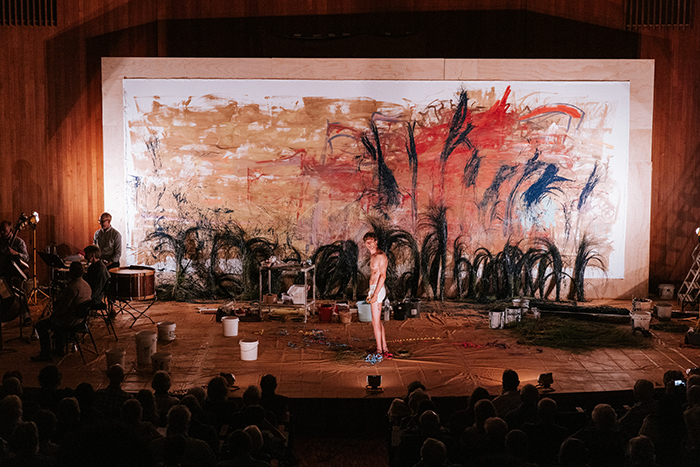
Australia Ensemble’s first concert of 2026 included a kaleidoscopic showcase of Stravinsky’s The Soldier’s Tale, his musical farewell to Russia.
The concert, on Saturday 14 March, was the first of four performances at the University by the Australia Ensemble UNSW this year.
Nino Rota’s Trio and Piano Trio no.1 by Shostakovich continued the program, which opened with Russian-Australian composer Elena Kats-Chernin’s Grand Rag, collaborating with leading pianist Andrea Lam.
The ensemble worked with Imara Savage (Director) and Michael Hankin (Set and Costume Designer) for this unique staging of The Soldier’s Tale, alongside actor and artistic collaborator Mitch Riley and visual artist Leon Bowers.
UNSW Creative Communities Director Sonia Maddock said the Australia Ensemble is a leading example of chamber music excellence in Australia.
“This was the most ambitious presentation the Australia Ensemble has undertaken in its 46-year history and demonstrated its commitment to creative innovation and collaboration. It cements the ensemble’s place as a jewel in the cultural life of UNSW,” she said.
Executive Director, Partnerships & Engagement, Alison Avery, said, “It was very special to watch this unique artistic performance with our UNSW community. The Australia Ensemble continues to raise the bar with innovative shows like this, and I can’t wait to see what’s in store for the remainder of the season.”
Hybrid artforms create a unique production
The collaboration was the result of Imara’s past work with Australia Ensemble UNSW’s Artistic Chair Paul Stanhope and work with directing colleague Mark Gaal (NIDA).
“I've worked fairly extensively in opera, chamber music, installation-type works, often in cross-disciplinary ways, so Stravinsky’s The Soldier’s Tale – to be read, played and danced – is very much my cup of tea,” Imara said.
Imara and Michael have previously developed opera and theatre projects together.
“We share an interest in locating a speculative, psychological or poetic space in which a work can exist, somewhere slightly beyond literal interpretation,” he said.
This work is unique because it falls outside traditional opera or theatre.
“The genre is hard to pin down. It’s a total hybrid pastiche, which is also represented in the pastiche of the music. It asks the audience to move between artforms. The focus is always shifting as to what artform is dominant on the stage – what is ‘telling the story’ at any given moment,” said Imara.
“There’s something quite chaotic about the work which we wanted to lean in to — the madness of the story itself and the soldier’s journey from something quite pastoral and simple to hallucinatory to the pits of hell.”
The chaotic nature of the work led to a similarly eclectic and unique visual style.
“The Soldier’s Tale exists in a state of stylistic flux,” Michael said.
“The score moves fluidly through tango, ragtime, waltz and military march — it’s deliberately fractured and eclectic. That gave Imara and me permission to avoid a singular aesthetic and instead explore a layered, slightly unstable visual world.”
Michael said the visual aspect of the production didn’t simply frame the action. It helped to shape the rhythm, tone and meaning alongside the music.
“We developed a visual language in which the environment begins in a sort of bucolic setting and gradually deteriorates over the course of the evening. It’s less about illustrating the narrative and more about constructing a world that becomes increasingly fractured, hallucinatory and unsettled.”

A unique development process
The creation of this production was unusual in comparison to the typical development process for opera or theatre.
“Mitch Riley [who acts in the production and was an artistic collaborator in its development] and I went into a room and explored the material for two weeks, including interrogating the original French text and making cuts,” said Imara.
“Then Michael Hankin came on board, and we talked through our discoveries, showed him material and wrestled with ideas. The next day Michael presented us with a design, and we spent two further weeks refining the staging. It’s been a quicker process than usual, because usually the conception phase can go over months, even years!”
For Michael, the speed and immediacy of the design development for this project was unusual but welcome.
“Often there’s a long conceptual incubation period before ideas are shared in the rehearsal room. Here, the design evolved in close dialogue with what was being discovered live in the space,” said Michael.
“I love working in this way and wish more processes could be conceived like this.”
More concerts to come in 2026
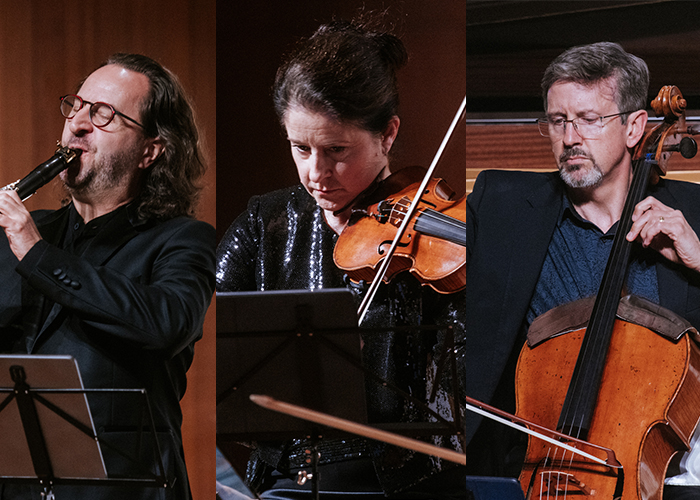
The Australia Ensemble UNSW has been a cornerstone of chamber music excellence in Australia since its foundation in 1980. Its key artists Dimity Hall (violin), David Griffiths (clarinet) and Julian Smiles (cello) work with renowned guest artists and production teams on a series of groundbreaking concerts each year.
The ensemble will perform three more concerts in 2026 in June, September and November.
Find out more about the 2026 program and book.
- Log in to post comments